Three tested routes through China’s most diverse province — from the classic highlights circuit to deep cultural immersions — with day-by-day plans, transport links, and insider timing tips.
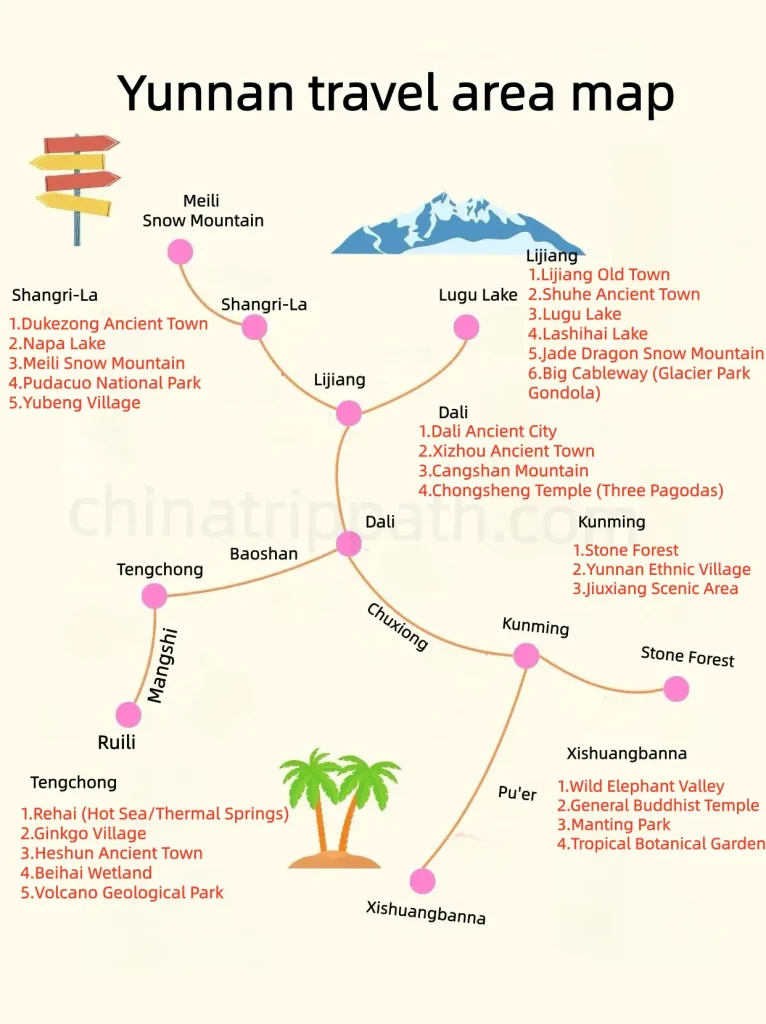
Yunnan’s greatest gift — and its greatest challenge for trip planning — is that it has too much. Too many incredible places, too many unforgettable meals, too many cultures to encounter, too many landscapes that deserve a full day of just staring. No single trip can cover everything, and the travelers who try to see it all in one visit always end up rushing through the places that deserved lingering.
These three itineraries solve that problem. Each one is designed around a realistic pace — enough time at each stop to go beyond the surface, eat well, get lost on purpose, and still move efficiently between destinations. The 7-day route covers the classic highlights. The 10-day adds cultural depth and a dramatic landscape. The 14-day is the comprehensive journey for travelers who want the full Yunnan experience.
Every route starts from Kunming, which is where most international flights arrive. For visas, apps, packing, and budget planning, see our ultimate Yunnan travel guide. For the cultural context that will make every destination richer, read our Yunnan culture guide before you leave.
What this guide covers: How to choose your route → 7-day classic itinerary → 10-day culture & nature itinerary → 14-day comprehensive itinerary → Transport tips → Budget estimates → Seasonal adjustments.
How to Choose Your Itinerary
7 days: The classic Yunnan circuit. Best for first-timers with limited vacation time. Covers the three essential destinations (Dali, Lijiang, Shangri-La) plus Kunming, with the option to hike Tiger Leaping Gorge. Misses southern Yunnan entirely.
10 days: Adds either Xishuangbanna (tropical/Dai culture) or Yuanyang + Jianshui (terraces/hidden gems) to the classic circuit. The best balance of breadth and depth. Our most recommended option for most travelers.
14 days: The full Yunnan experience — north to south, highland to tropical. Covers the classic circuit plus Xishuangbanna, southeastern Yunnan, and time for spontaneous detours. Requires comfort with Chinese domestic travel logistics.
The 7-Day Classic: Kunming → Dali → Lijiang → Shangri-La
This is Yunnan’s signature route — the path most first-time visitors follow, and for good reason. It moves north through the province’s most celebrated destinations, climbing from the mild plateau to the Tibetan highlands, with each stop offering a distinct cultural and natural personality.
Day 1: Arrive in Kunming
Land at Kunming Changshui Airport. Transfer to a hotel in the Cuihu (Green Lake) district. If you arrive before 2 PM, spend the afternoon at Green Lake Park — watch the Siberian gulls (winter) or just soak in Kunming’s easy-going energy. Evening: walk to the Bird and Flower Market area for dinner — try small pot rice noodles (xiǎo guō mǐxiàn), Kunming’s signature noodle dish.
Day 2: Kunming → Stone Forest → Dali
Early morning departure for the Stone Forest (1.5 hours by bus). Spend 3 hours exploring the limestone labyrinth, hire a Sani guide for the Ashima legend. Return to Kunming, then catch the afternoon high-speed train to Dali (2 hours). Check into a guesthouse in the Ancient Town. Evening: explore the old town streets and eat Bai-style Erhai fish for dinner.
Day 3: Dali — Erhai Lake & Villages
Full day exploring Dali. Morning: rent an e-bike and ride to Xizhou — visit the Bai three-course tea ceremony, eat Xizhou baba for breakfast, browse the morning market. Continue to Zhoucheng for the Bai tie-dye workshops. Afternoon: cycle the Erhai lakeside toward Shuanglang for golden-hour lake views. Return to the ancient town for dinner.
Day 4: Dali → Lijiang
Morning: visit the Three Pagodas of Chongsheng Temple. Take the midday train to Lijiang (1.5 hours). Afternoon: explore the UNESCO Old Town — Sifang Square, Mu Palace, the canal-side streets. Climb Wangu Tower on Lion Hill for the sunset panorama over the old town rooftops with Jade Dragon Snow Mountain behind. Evening: attend a Naxi Ancient Music performance.
Day 5: Lijiang — Jade Dragon Snow Mountain
Full day at Jade Dragon Snow Mountain. Take the glacier cable car to 4,506 meters (book tickets a day ahead in peak season). Walk the boardwalk to the viewing platform — move slowly at altitude. Afternoon: descend to Blue Moon Valley for the turquoise pools. Return to Lijiang. Evening: explore Baisha Ancient Town and the Baisha Murals for a quieter cultural experience.
Day 6: Lijiang → Tiger Leaping Gorge → Shangri-La
Early departure for Tiger Leaping Gorge. Option A (full day): hike a section of the high trail (4–5 hours) and continue to Shangri-La by evening. Option B (lighter): visit the Upper Gorge viewpoint via the low road (2 hours total), then continue by bus to Shangri-La (2.5 hours from Tina’s). Evening: join the communal dancing (guozhuang) in Dukezong Old Town.
Day 7: Shangri-La → Depart
Morning: visit Songzanlin Monastery — Yunnan’s largest Tibetan Buddhist monastery. Spin the giant prayer wheel on Guishan Hill. If time allows, drive to Napa Lake for highland grassland views. Afternoon: fly from Shangri-La Diqing Airport to Kunming (1 hour) for your onward connection.
7-day budget estimate: ¥4,000–6,000 per person (mid-range). Includes accommodation, transport, meals, and entrance fees. Flights to/from Kunming are extra.
The 10-Day Deep Dive: Classic Route + Xishuangbanna
Take the 7-day route above and add 3 days in the tropical south — a dramatic shift from Tibetan highlands to Dai rainforest that showcases the full range of Yunnan’s diversity.
Days 1–6: Same as the 7-Day Classic
Follow the Kunming → Dali → Lijiang → Shangri-La route above.
Day 7: Shangri-La → Kunming → Xishuangbanna
Morning flight from Shangri-La to Kunming. Afternoon connecting flight to Jinghong (Xishuangbanna) — or take the new Yumo Railway (3.5 hours from Kunming), one of China’s most scenic rail journeys. Evening: dive straight into the Manting Road night market for Dai grilled fish, bamboo-tube rice, barbecue skewers, and tropical fruit shakes.
Day 8: Xishuangbanna — Dai Culture & Rainforest
Morning: visit Ganlanba (Dai Garden) for traditional Dai villages, stilted bamboo houses, and active Buddhist temples. Watch the morning alms-giving ceremony. Afternoon: Xishuangbanna Tropical Botanical Garden (half day) or Wild Elephant Valley. Evening: free for exploring Jinghong’s riverside promenade and local restaurants.
Day 9: Xishuangbanna — Tea Mountains or Rainforest Canopy
Option A: Visit an ancient Pu’er tea mountain near Menghai — walk among 500-year-old tea trees and taste fresh Pu’er from the source. Option B: Wangtianshu Rainforest canopy walkway — 36 meters above the jungle floor. Evening: final night market feast.
Day 10: Xishuangbanna → Depart
Morning: Manting Park (former Dai royal garden) or a leisurely Jinghong exploration. Afternoon: fly from Jinghong to Kunming (1 hour) for your onward connection.
10-day budget estimate: ¥6,000–9,000 per person (mid-range). The Shangri-La–Kunming–Jinghong flights add ¥800–1,200.
The 14-Day Complete: North to South, Highland to Tropical
The ultimate Yunnan itinerary — covering the classic northwest circuit, the tropical south, and the often-missed southeastern gems. This route requires comfort with Chinese transport (trains, buses, occasional flights) but rewards with the most comprehensive picture of the province.
Days 1–7: The Classic Northwest Circuit
Follow the 7-day itinerary: Kunming → Stone Forest → Dali → Lijiang → Tiger Leaping Gorge → Shangri-La. Take the full 2-day Tiger Leaping Gorge high trail trek if your fitness allows — it’s the single best hiking experience in Yunnan and the extra day is worth it.
Day 8: Shangri-La → Kunming
Morning: Pudacuo National Park — alpine lakes and virgin forest at 3,500 meters. Afternoon: fly to Kunming. Evening: revisit Kunming for a wild mushroom hot pot dinner (if visiting June–October) or explore a neighborhood you missed on Day 1.
Days 9–10: Kunming → Jianshui → Yuanyang
Day 9: High-speed train to Jianshui Ancient Town (1.5 hours). Explore the Confucius Temple, Zhu Family Garden, and the 17-arch Shuanglong Bridge. Evening: the legendary grilled tofu night market. Overnight in Jianshui.
Day 10: Bus to Yuanyang Rice Terraces (2.5 hours). Afternoon: Bada sunset viewpoint. Overnight in a Duoyishu guesthouse.
Day 11: Yuanyang
Sunrise at Duoyishu (set alarm for 5:30 AM — it’s worth it). Morning: explore Hani villages (Qingkou or Azheke). Afternoon: Tiger’s Mouth viewpoint and a walk among the terraces. Sunset at Bada. Overnight in Duoyishu.
Day 12: Yuanyang → Kunming → Xishuangbanna
Morning: second sunrise attempt or departure. Travel back to Kunming via Jianshui. Evening flight or train to Xishuangbanna. Night market dinner.
Days 13–14: Xishuangbanna
Day 13: Dai villages, Tropical Botanical Garden, and Pu’er tea mountain visit. Day 14: Rainforest canopy walk or Wild Elephant Valley. Afternoon departure from Jinghong.
14-day budget estimate: ¥9,000–14,000 per person (mid-range). Includes all transport, accommodation, meals, and entrance fees. International flights extra.
Transport Tips for All Itineraries
High-speed trains: The backbone of Yunnan travel. Kunming → Dali (2 hours), Dali → Lijiang (1.5 hours), Kunming → Jianshui (1.5 hours), Kunming → Xishuangbanna (3.5 hours via Yumo Railway). Book on Trip.com or the 12306 app.
Flights: Shangri-La → Kunming (1 hour) and Kunming → Jinghong (1 hour) are the most useful flights. Book on Trip.com or Ctrip. Shangri-La flights can be disrupted by weather — have a backup plan.
Buses: Still necessary for Lijiang → Shangri-La (4 hours), Tiger Leaping Gorge access, Jianshui → Yuanyang (2.5 hours), and rural destinations. Book at bus stations or through your hotel.
Didi: Works in all cities and many towns. Essential for day trips, airport transfers, and getting to viewpoints not served by public transport.
For the full transport guide — including how to set up Chinese apps, buy train tickets, and navigate airports — see our ultimate Yunnan travel guide.
Seasonal Adjustments
Spring (March–May): The best all-around season. Wildflowers on trails, clear mountain views, comfortable temperatures everywhere. The Third Month Fair in Dali (March/April) and the Water Splashing Festival in Xishuangbanna (April) are major cultural draws. The Yuanyang terraces are in their late flooding stage — still reflective.
Summer (June–September): Mushroom season in Kunming (don’t miss wild mushroom hot pot). Lush green landscapes everywhere. Yuanyang terraces are in growing/green stage. Rainy season means afternoon showers and occasional mountain cloud cover — pack rain gear.
Autumn (September–November): Clear skies, golden light, comfortable temperatures. Best mountain visibility in Shangri-La and at Tiger Leaping Gorge. Yuanyang harvest colors (October). The best season for photography across the province.
Winter (December–February): Dry and clear in most regions. Cold in Shangri-La and Lijiang (pack warm layers). Yuanyang flooding season begins (November) — peak terrace photography. Siberian gulls arrive at Kunming’s Green Lake. Fewer tourists everywhere.
For the Yunnan food calendar — including what’s in season when — see our food guide. For festival timing, check our festivals guide.
The 7-day classic route: Kunming → Dali → Lijiang → Shangri-La. It covers the essential highlights — ancient towns, Erhai Lake, Jade Dragon Snow Mountain, Tiger Leaping Gorge, and Tibetan culture — with efficient train connections. If you have 10 days, add Xishuangbanna for the tropical contrast.
Possible but very rushed. A tight 5-day route: Day 1 Kunming, Day 2 train to Dali, Day 3 Dali, Day 4 train to Lijiang, Day 5 Lijiang + depart. You’d miss Shangri-La, Tiger Leaping Gorge, and the south. If you only have 5 days, consider focusing on just 2 destinations in depth rather than racing through 4.
Yes. The high-speed train network, Didi ride-hailing, and well-established tourist infrastructure make independent travel straightforward. English is limited outside major hotels, so a translation app is essential. The main challenges: buying train tickets (use Trip.com), navigating bus stations, and communicating food preferences at local restaurants.
Budget: ¥200–400/day (hostels, street food, public transport). Mid-range: ¥500–800/day (boutique hotels, restaurants, some taxis). Comfort: ¥1,000+/day (4-star hotels, private cars, premium experiences). A 10-day mid-range trip runs ¥6,000–9,000 per person, excluding international flights.
Independent travel is recommended for most visitors — Yunnan’s infrastructure is good, the pace is relaxed, and the best experiences (morning markets, street food, spontaneous village encounters) happen off the tour-bus routes. Organized tours are useful for specific activities: Tiger Leaping Gorge guided treks, tea mountain visits, and Dongchuan Red Land day trips.