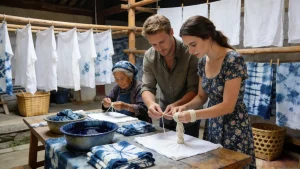
At a mountain lake on the Yunnan-Sichuan border, women run the households, children belong to the mother’s family, and “walking marriages” replace the wedding altar — a social system that has fascinated anthropologists and challenged assumptions for centuries.
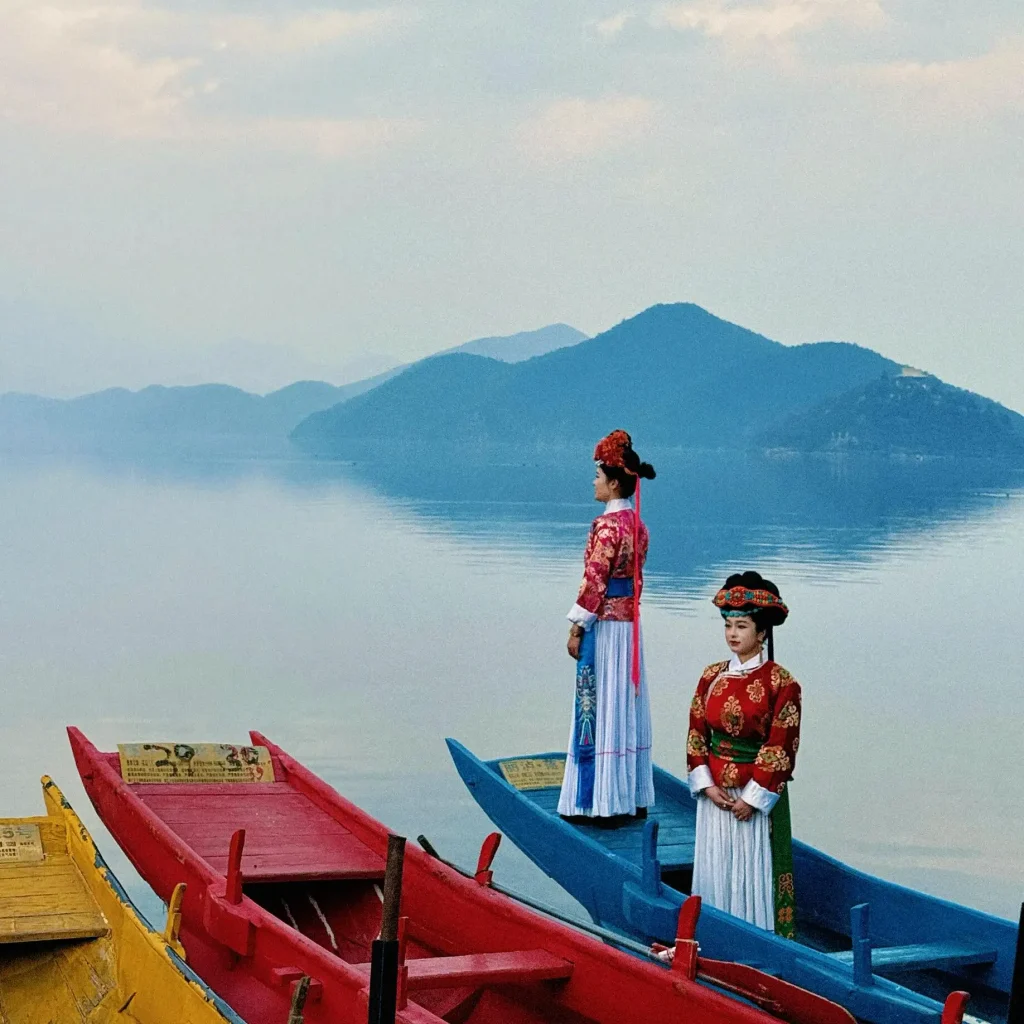
On the border of Yunnan and Sichuan provinces, at an altitude of 2,685 meters, lies Lugu Lake — one of the deepest and clearest freshwater lakes in China, ringed by forested mountains and home to the Mosuo people. The lake alone would be worth the journey: water so transparent you can see the bottom at 12 meters, changing color from turquoise to sapphire to obsidian as clouds pass overhead. But what makes Lugu Lake truly extraordinary isn’t the scenery — it’s the society that lives alongside it.
The Mosuo (approximately 40,000 people) are one of the last matrilineal societies on Earth. Women head the households, manage the family finances, and pass property and family name through the female line. Men live in their mothers’ homes throughout their lives. And the institution that most captures outsiders’ imagination — “walking marriage” (zǒu hūn) — replaces formal marriage with a system where couples maintain separate households and men visit their partners at night, returning to their mothers’ homes by morning.
This guide explores Mosuo culture with the depth and nuance it deserves — beyond the sensationalist headlines that have sometimes reduced a complex society to a curiosity. For how the Mosuo fit into Yunnan’s broader cultural landscape, see our ethnic minorities guide and Yunnan culture guide.
What this guide covers: Who the Mosuo are → The matrilineal system → Walking marriage → The Grandmother house → Mosuo religion → Lugu Lake itself → How to visit → Ethical tourism → FAQ.
Who Are the Mosuo?
The Mosuo are officially classified by the Chinese government as a branch of the Naxi ethnic group — a classification the Mosuo themselves generally reject. While they share some ancestral roots with the Naxi people of Lijiang, the Mosuo have a fundamentally different social structure, religious practice, and cultural identity. The Naxi are patrilineal and practice the Dongba religion; the Mosuo are matrilineal and practice a blend of Tibetan Buddhism and indigenous Daba animism. The two groups consider themselves distinct peoples.
The Mosuo have lived around Lugu Lake for at least 1,500 years, developing their social system in relative geographic isolation — the lake is surrounded by mountains and was, until the late 20th century, extremely difficult to reach. This isolation protected the matrilineal system from the assimilationist pressures that transformed most other matrilineal societies in China and Asia.
Today, approximately 40,000 Mosuo live around Lugu Lake and in the surrounding mountain valleys, with communities on both the Yunnan and Sichuan sides of the border. Tourism has become a major economic force since the early 2000s, bringing both opportunities and challenges to a society that is simultaneously trying to preserve its traditions and participate in modern Chinese economic life.
The Matrilineal System
The Mosuo social structure is built on a principle that inverts the assumptions of most world cultures: the family line, property, and household authority pass through the mother, not the father.
The Grandmother House (Zǔmǔ Wū)
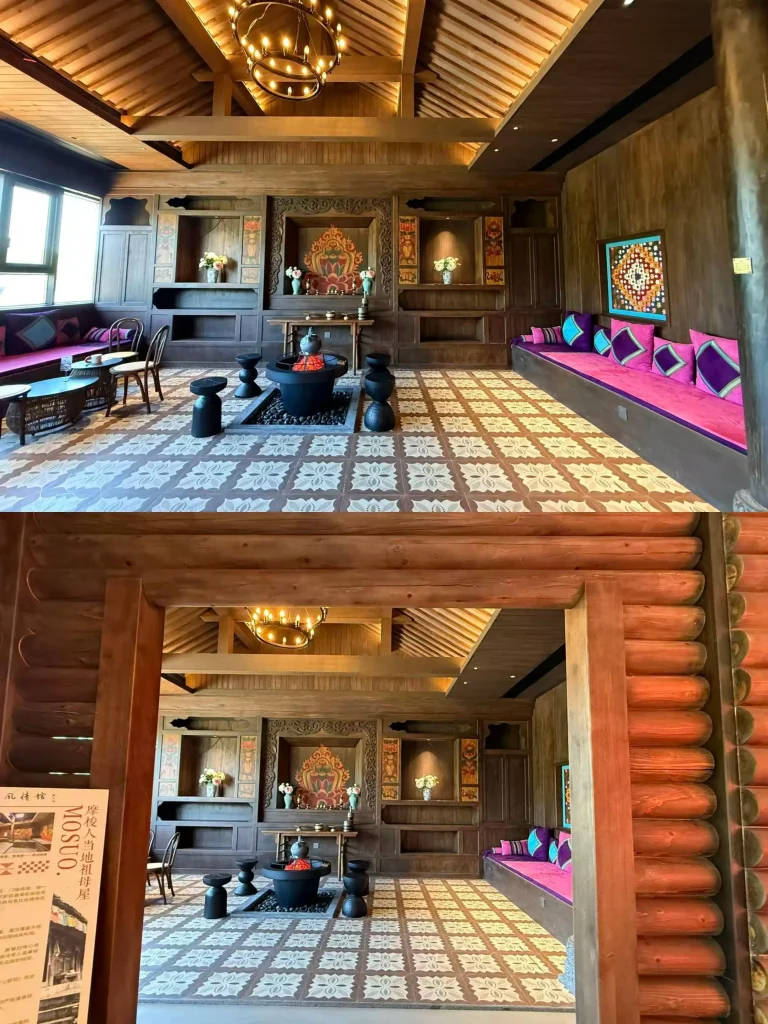
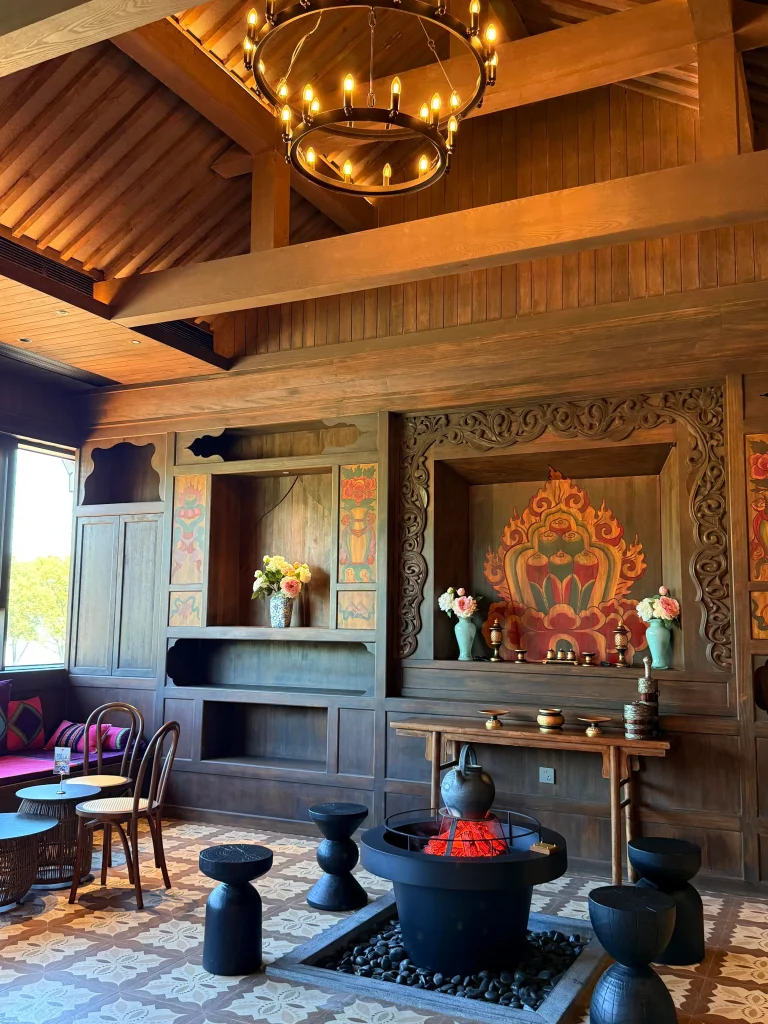
The center of Mosuo life is the Grandmother House — a large, multi-generational home headed by the eldest and most capable woman in the family (the “Ah Mi,” or matriarch). The house shelters the extended matrilineal family: grandmother, her daughters, their children, and the grandmother’s brothers and sons. A household of 15–20 people living under one roof is common.
The Grandmother House is more than a dwelling — it’s the institution. The matriarch manages household finances, makes major decisions, resolves disputes, and allocates work. Property — the house, the land, the livestock — belongs to the matrilineal family, not to individuals, and is passed from mother to daughter. Men contribute their labor to the household but do not own its property. If a man leaves (or is expelled), he returns to his own mother’s household with nothing — incentivizing cooperative behavior and reducing domestic conflict.
The heart of the Grandmother House is the fire pit (huǒ táng), which burns continuously and serves as the family’s gathering place. Meals are eaten around the fire pit. Decisions are made there. Stories are told there. The fire pit is sacred — guests should never step over it, place shoes near it, or throw trash into it.
Women’s Roles
Mosuo women manage the household economy — farming, animal husbandry, trade, tourism businesses, and family finances. Women own the houses, make the major economic decisions, and organize community events. In recent decades, Mosuo women have also become the primary interface with the tourism industry — running guesthouses, guiding visitors, and representing their culture to the outside world.
This doesn’t mean men are powerless. Mosuo men handle heavy agricultural labor, fishing, construction, trade with outside communities, and religious duties. Men serve as the Daba priests (the indigenous religious practitioners) and manage the community’s external relations. The system is better described as complementary rather than female-dominant — each gender has defined spheres of authority that are respected.
Walking Marriage (Zǒu Hūn)
The aspect of Mosuo culture that generates the most outside fascination — and the most misunderstanding — is “walking marriage,” the system of romantic relationships that replaces formal marriage.
How It Works
In a walking marriage, a couple does not live together. The woman stays in her mother’s Grandmother House; the man stays in his. When they form a romantic partnership, the man “walks” to the woman’s home in the evening, spending the night with her in a private room (the “flower room” or huā fáng). He returns to his mother’s home before dawn. The arrangement continues as long as both parties wish — there is no formal ceremony, no legal contract, and either partner can end the relationship at any time.
Children born from walking marriages belong to the mother’s family. They carry the mother’s family name, live in the mother’s Grandmother House, and are raised by the extended matrilineal family — including the mother’s brothers, who serve as male role models (a role called “uncle-father”). The biological father may or may not be publicly acknowledged; his primary responsibility is to the children of his own sisters, not his biological offspring.
What It Isn’t
Walking marriage has been sensationalized by media and tourism marketing — sometimes reduced to “the place where men and women have free love” or even described as promiscuous. This is a deep misunderstanding. Walking marriages involve genuine emotional commitment; many last for life. The system emphasizes mutual attraction and freedom of choice, but it’s governed by social norms, family expectations, and community standards. Casual encounters do occur, as in any society, but the norm is long-term partnership — just without the legal and financial entanglements of formal marriage.
The system’s practical benefits are significant. Because property stays with the matrilineal family, there is no divorce-related property dispute — a major source of conflict in societies worldwide. Women retain full economic independence throughout their lives. Children always have a stable, multi-generational support network regardless of their parents’ relationship status. And the freedom to leave a relationship without financial penalty means that partnerships are maintained by genuine affection rather than economic dependency.
Religion & Spiritual Life
The Mosuo practice two religious traditions simultaneously — a blend that reflects their geographic position between the Tibetan Buddhist world and the indigenous traditions of southern China.
Daba Religion: The indigenous Mosuo spiritual tradition, practiced by Daba priests who serve as the community’s ritual specialists. Daba rites involve nature worship, ancestor veneration, animal sacrifice, and the chanting of sacred texts that preserve Mosuo mythology and history. The Daba tradition is oral — no written script — and the declining number of practicing priests has made preservation a pressing concern.
Tibetan Buddhism: Introduced to the Mosuo region several centuries ago through contact with Tibetan communities to the north. Many Mosuo families practice Tibetan Buddhism alongside the Daba tradition — attending monastery ceremonies, spinning prayer wheels, and observing Buddhist holidays. The Zhamei Monastery on Lugu Lake’s northern shore is the area’s most important Buddhist site.
The coexistence of these two traditions — one indigenous and animist, the other imported and Buddhist — is practiced without contradiction. Families may consult a Daba priest for birth rituals and a Buddhist lama for funeral rites. The pragmatic spiritual flexibility is characteristic of the Mosuo worldview.
Lugu Lake: The Setting
Lugu Lake itself is one of China’s most beautiful natural settings — and understanding the lake is essential to understanding the Mosuo, whose identity is deeply intertwined with its waters.
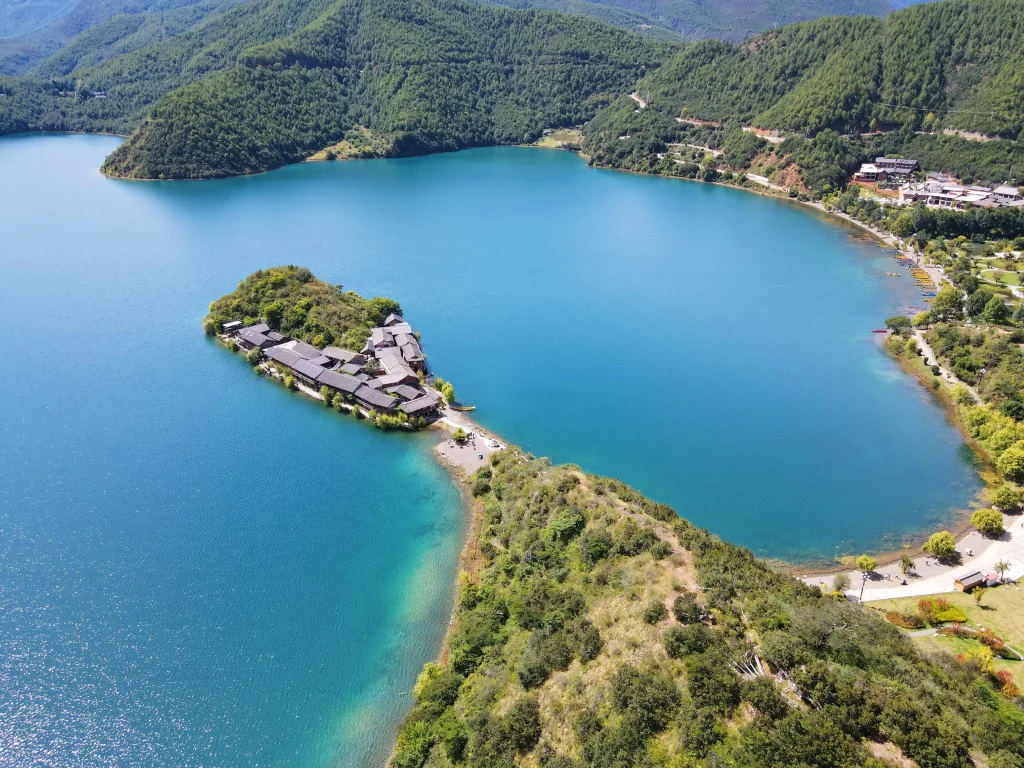
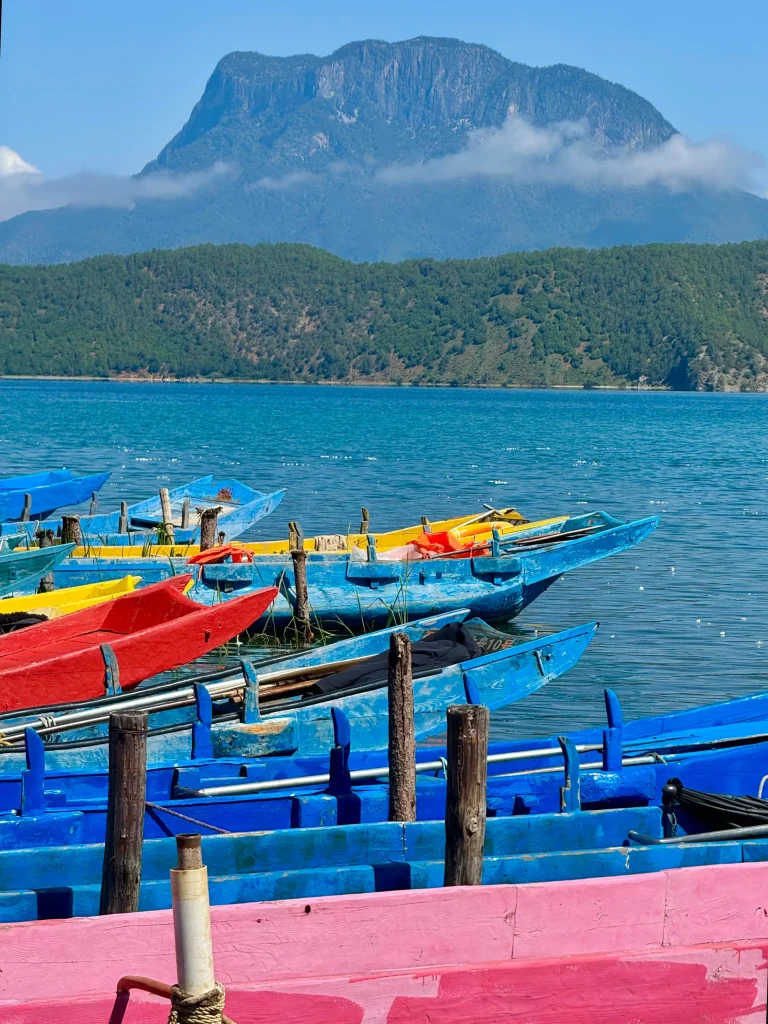
The lake covers 50 square kilometers at 2,685 meters altitude, reaching depths of 93 meters. The water clarity is legendary — underwater plants are visible at 12 meters — and the color shifts through the day from dawn turquoise to afternoon sapphire to sunset gold. Five islands dot the lake surface, including the sacred Liwubi Island, home to a Tibetan Buddhist monastery that Mosuo families visit on festival days.
Key Experiences
Dugout canoe (pig trough boat): The iconic Lugu Lake experience — riding in a traditional hand-carved wooden canoe, so named because the narrow hull resembles a pig’s feeding trough. Mosuo women paddle the canoes across the lake to islands, fishing grounds, and neighboring villages. The experience is quiet, intimate, and deeply scenic.
Lige Peninsula: The most photogenic village on the lake — a small promontory jutting into the water with Mosuo homes, guesthouses, and unobstructed panoramic views. Best for sunrise.
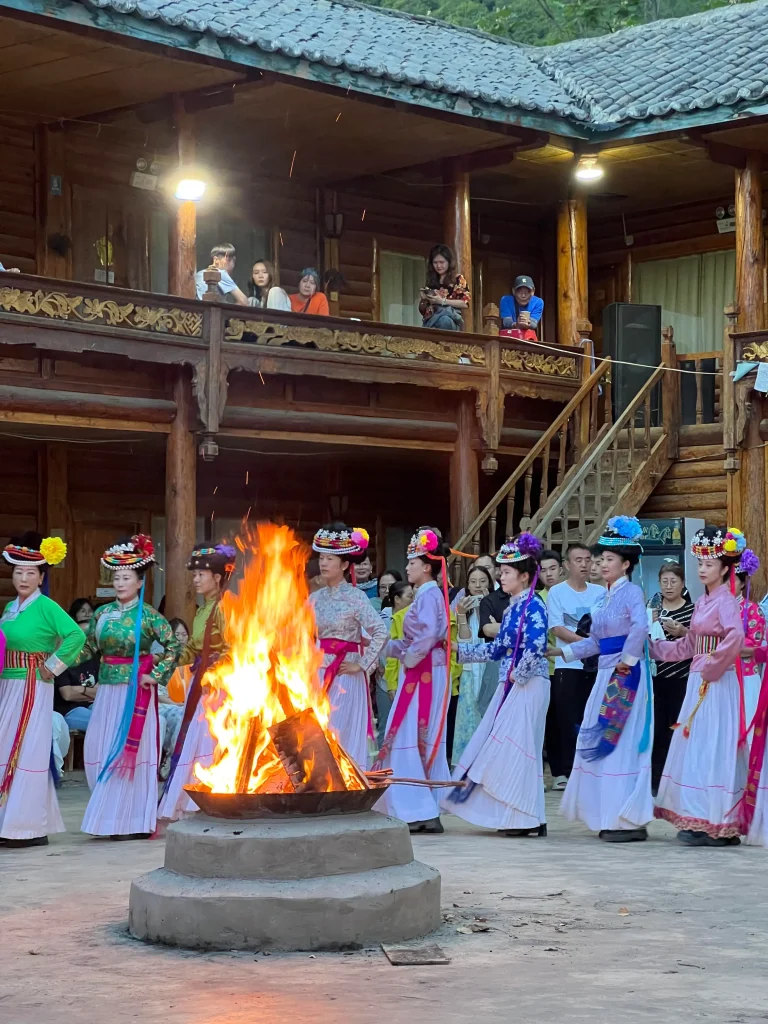
Luoshui Village: The largest Mosuo lakeside settlement and the main tourist hub on the Yunnan side. Guesthouses, restaurants, and the departure point for boat trips and cycling. The evening bonfire dance (Jiǎcuō wǔ) — where Mosuo men and women dance in concentric circles — is held nightly in the village square.
Goddess Mountain (Gémǔ Shān): The 3,754-meter peak overlooking Lugu Lake, considered the physical embodiment of the Mosuo’s guardian goddess. Mosuo families make pilgrimages to the mountain during the Turning Mountain Festival (July). A hiking trail reaches a viewpoint overlooking the entire lake.
Cycling the lake: A paved road circles the lake (approximately 70 km). E-bikes and regular bicycles are available for rent (¥50–100/day) in Luoshui and Lige. The full circuit takes 4–6 hours and passes through Mosuo, Pumi, and Yi villages on both the Yunnan and Sichuan sides.

How to Visit
From Lijiang: The most common route. Bus from Lijiang Tourist Bus Station (5–6 hours, ¥100–120) or hired car (4.5 hours, ¥600–800). The road is winding and scenic — through mountain passes with stunning views.
From Chengdu/Xichang (Sichuan side): Bus from Xichang to Lugu Lake Sichuan entrance (4 hours). The Sichuan side is less developed and quieter.
By air: Ninglang Lugu Lake Airport has limited flights from Kunming (1 hour) and Chengdu. Then a 1-hour transfer to the lake.
Where to stay: Lige Peninsula for the best lake views and a smaller-village atmosphere. Luoshui for more convenience and guesthouse options. Many guesthouses are Mosuo family-run — staying in one provides cultural immersion alongside accommodation. Budget: ¥100–400/night.
How many days: 2 nights / 3 days minimum. Day 1: arrive, settle, evening bonfire dance. Day 2: canoe ride, cycling, village visits, Grandmother House visit. Day 3: Goddess Mountain or island visit, depart. Longer stays reward with deeper cultural encounters.
For incorporating Lugu Lake into a broader Yunnan route, see our Yunnan itinerary guide. For Lijiang travel logistics, see our destination guide.
Ethical Tourism & Respectful Engagement
Lugu Lake’s tourism boom has brought significant changes to Mosuo society — not all of them positive. Engaging thoughtfully matters:
Don’t reduce walking marriage to a spectacle. The most common complaint from Mosuo people about tourism is the prurient curiosity about walking marriage — visitors asking invasive personal questions, tour guides sensationalizing the practice, and media framing the Mosuo as sexually exotic. Walking marriage is a serious social institution with deep cultural logic. Approach it with the same respect you’d give any society’s family structures.
Visit a Grandmother House with a guide. Several Mosuo families in Luoshui and Lige welcome visitors into their Grandmother Houses for cultural explanations (¥20–50 per person). A Mosuo host will explain the family structure, the fire pit traditions, and the matrilineal system firsthand. This is far more meaningful than reading about it.
Attend the bonfire dance. The nightly Jiǎcuō dance in Luoshui is participatory and genuinely communal — join the circle, follow the steps, and enjoy the atmosphere. It’s the most accessible entry point into Mosuo social life.
Support Mosuo-run businesses. Choose Mosuo-run guesthouses over chain hotels. Eat at Mosuo family restaurants. Buy handicrafts from Mosuo artisans. Your economic choices directly affect who benefits from tourism.
Respect sacred sites. The fire pit in a Grandmother House is sacred — don’t step over it, sit on the sacred seat (reserved for the matriarch), or throw anything into it. At Zhamei Monastery, follow standard Buddhist etiquette. On Goddess Mountain, treat the pilgrimage path respectfully.
For the broader context of Yunnan’s ethnic minority cultures and how the Mosuo fit into the province’s extraordinary diversity, explore our comprehensive guides.
A system of romantic relationships where couples don’t live together. The man ‘walks’ to the woman’s home in the evening and returns to his own mother’s home by morning. There’s no formal wedding or legal contract — either partner can end the relationship freely. Children belong to the mother’s family. It’s a serious social institution, not casual — many walking marriages last for life.
It’s more accurately described as matrilineal (descent through the mother) and matrilocal (residence in the mother’s household). Women head households, manage finances, and inherit property. Men have their own spheres of authority — religious duties, external trade, heavy labor. The system is complementary rather than female-dominant, though women hold the central structural position.
Bus from Lijiang Tourist Bus Station takes 5–6 hours (¥100–120). Hired car takes 4.5 hours (¥600–800 for the car). The road is winding with mountain passes. There are also limited flights to Ninglang Lugu Lake Airport from Kunming and Chengdu. Budget 2–3 nights at the lake minimum.
Lige Peninsula for the best lake views and intimate atmosphere. Luoshui Village for more convenience and options. Both have Mosuo family-run guesthouses (¥100–400/night) that provide cultural immersion. Staying in a Mosuo-run guesthouse is strongly recommended over chain alternatives.
Absolutely. The combination of one of China’s most beautiful lakes with one of the world’s last matrilineal societies creates an experience unlike anything else in Yunnan — or anywhere else. The journey is long (5–6 hours from Lijiang), but the cultural depth, stunning scenery, and unique social encounters make it one of the province’s most memorable destinations.