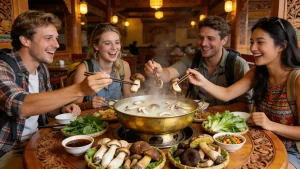
A bowl of golden broth so hot it cooks paper-thin meat at the table, a love story that made it famous, and a ritual of assembly that turns lunch into performance — this is Yunnan’s culinary masterpiece.
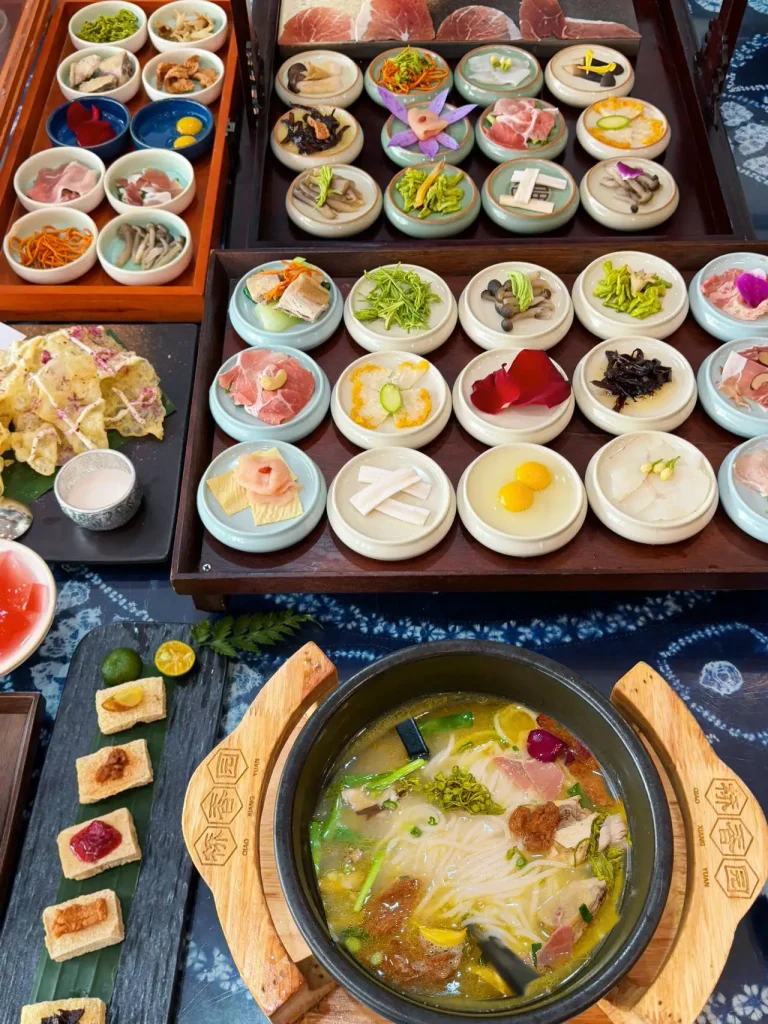
If Yunnan has a national dish, this is it. Crossing the Bridge Rice Noodles (guò qiáo mǐxiàn) is not just a bowl of noodle soup — it’s a culinary ceremony, a love story, and a sensory experience that has been perfected over 300 years. The dish arrives at your table as a spectacle: a massive bowl of golden chicken broth, filmed with a thin layer of oil that seals in the heat, surrounded by a dozen or more small dishes of raw ingredients — paper-thin slices of chicken, pork, and fish, quail eggs, tofu skin, chrysanthemum petals, chives, and fresh rice noodles. You add them to the broth in careful sequence, watching each ingredient cook in seconds in the superheated liquid.
The dish is a symbol of Kunming and Yunnan identity — the way ramen represents Japan or pho represents Vietnam. No trip to Yunnan is complete without eating it, and this guide covers everything: the origin story, how it’s made, the ritual of eating it properly, and where to find the best versions across the province. For the full Yunnan food picture, see our Yunnan food guide.
What this guide covers: The love story origin → How it works → The correct eating order → Where to eat it in Kunming → Regional variations → How much to spend → FAQ.
The Love Story Behind the Dish
The origin legend — and there are several versions, but this is the most enduring — dates to the Qing Dynasty in the town of Mengzi, 300 km south of Kunming. A scholar was studying for the imperial examinations on an island in a lake, so absorbed in his books that he kept forgetting to eat. His devoted wife prepared noodle soup each day and carried it across a long bridge to the island — but by the time she arrived, the soup had always gone cold.
One day, she noticed that a bowl of chicken broth with a layer of oil on the surface stayed hot far longer than ordinary soup. She began assembling the dish differently: bringing the piping-hot oil-sealed broth in one container and the raw ingredients in separate dishes, adding them at the table so everything was perfectly fresh and hot. The scholar loved it. He passed his examinations. And the dish — “crossing the bridge” noodles — became famous.
Whether the story is historically accurate is beside the point. The technique is real, and the ingenuity is genuine: that thin oil layer (chicken fat, sometimes goose fat) keeps the broth at near-boiling temperature long enough to cook raw ingredients at the table. It’s a brilliant solution to a simple problem — and three centuries later, it still works perfectly.
How It Works: The Anatomy of a Bowl
A proper Crossing the Bridge Rice Noodles set consists of three elements:
The broth: A rich, clear chicken stock (sometimes with pork bone), simmered for hours until golden and deeply flavored. The surface is filmed with a thin layer of rendered poultry fat — this is the “bridge” trick that traps the heat. The broth arrives at your table at near-boiling temperature, though it doesn’t appear to be boiling because the oil layer suppresses bubbling. Don’t test the temperature with your finger.
The accompaniments (pèi cài): A parade of small dishes containing raw and semi-prepared ingredients. A standard mid-range set includes: paper-thin slices of raw chicken breast, pork loin, and freshwater fish; quail eggs; sliced ham; tofu skin (dòu fǔ pí); chrysanthemum petals; chives or scallions; lettuce or pea shoots; and sometimes extras like squid, liver, or sea cucumber depending on the restaurant’s grade.
The noodles: Fresh rice noodles (mǐxiàn) — Yunnan’s signature starch. These are smooth, slightly chewy, and distinctly different from the wheat noodles dominant in northern China. They’re added last, after the raw ingredients have cooked.
The Correct Eating Order
There’s a proper sequence — not arbitrary, but based on cooking times:
Step 1 — Raw meats first. Slide the thin-sliced raw chicken, pork, and fish into the broth. The super-heated liquid cooks them in 10–15 seconds. The meat must go in first while the broth is hottest.
Step 2 — Eggs and tofu skin. Crack the quail eggs into the broth and add the tofu skin. These need slightly more time — 20–30 seconds.
Step 3 — Vegetables and herbs. Add the greens, chrysanthemum petals, chives, and any other vegetable items. These cook in seconds and add color and freshness.
Step 4 — Noodles last. Slide the rice noodles into the bowl. They’re already cooked — they just need to absorb the broth and warm through.
Step 5 — Season. Add chili oil, vinegar, or salt to taste. Most restaurants provide condiment stations with a range of options.
Common mistake: Dumping everything in at once. This drops the broth temperature too quickly, leaving the raw meats undercooked. Patience is part of the ritual.
Where to Eat Crossing the Bridge Rice Noodles
Kunming: The Capital of Guoqiao Mixian
Kunming is the epicenter — where the dish reached its modern form and where competition between restaurants has driven quality to extraordinary levels.
Jianxin Yuan : The most famous chain — multiple locations across Kunming, with the Baoshan Street branch being the original. Sets range from ¥20 (basic) to ¥200+ (premium with sea cucumber and exotic ingredients). The mid-range sets (¥40–80) offer the best value-to-quality ratio. Consistently excellent broth.
Qiao Xiang Yuan : Another beloved institution, slightly more upscale than Jianxin Yuan. Known for particularly rich, golden broth and generous accompaniment plates. The Dongfeng Road branch is the most convenient for visitors.
Guo Qiao Mixian restaurants near Green Lake: Several reliable establishments within walking distance of Green Lake Park cater to both locals and visitors. Look for the ones packed with Chinese diners at lunchtime — that’s your quality indicator.
Mengzi: The Birthplace
The small city of Mengzi (3 hours south of Kunming by train) is where the dish was invented, and locals insist that Mengzi guoqiao mixian is the original and best. The broth tends to be lighter and more purely chicken-flavored than the Kunming versions, and the rice noodles are made from local rice varieties. If you’re visiting Yuanyang Rice Terraces, Mengzi is on the route and worth a lunch stop specifically for this purpose.
Across Yunnan
You’ll find Crossing the Bridge Rice Noodles in every city in Yunnan — Dali, Lijiang, Shangri-La, Xishuangbanna — and quality varies widely. In tourist areas, prices are higher and standards sometimes lower. For the most authentic experience outside Kunming, look for restaurants that cater primarily to local diners rather than tourists.
What to Spend
Crossing the Bridge Rice Noodles comes in grades based on the number and quality of accompaniments:
Basic (¥15–30): Simple broth with basic meat slices, vegetables, and noodles. Perfectly satisfying for a quick lunch.
Mid-range (¥40–80): The sweet spot. Rich broth, 10–15 accompaniment dishes, higher-quality meats, and often chrysanthemum petals and quail eggs. This is what most locals order for a proper meal.
Premium (¥100–300+): Elaborate sets with exotic ingredients — sea cucumber, abalone, wild mushrooms, premium ham. The broth is usually exceptional at this level. Worth trying once for the full experience.
For other Kunming noodle dishes to try alongside guoqiao mixian, see our Yunnan street food guide — small pot rice noodles (xiǎo guō mǐxiàn) and erkuai are equally essential. For the complete Yunnan food picture, our province-wide guide maps every regional specialty.
Small Pot Rice Noodles: The Local’s Alternative
While Crossing the Bridge is the famous one, many Kunming locals will tell you that their daily noodle fix is actually small pot rice noodles (xiǎo guō mǐxiàn) — individual portions cooked in tiny clay pots directly over a flame, with your choice of toppings (minced pork, tomato-egg, fresh mushrooms, pickled vegetables). It’s cheaper (¥8–15), faster, and arguably more representative of everyday Kunming eating. Try both on the same day for the full Kunming noodle education.
Yunnan’s signature dish — a bowl of oil-sealed super-hot chicken broth served with an array of raw ingredients (thin-sliced meats, quail eggs, vegetables, chrysanthemum petals) that you add at the table in sequence, cooking each item in seconds. Fresh rice noodles go in last. It’s a 300-year-old culinary tradition and Kunming’s most famous food.
According to legend, a scholar’s wife carried noodle soup across a bridge to her husband studying on an island. She discovered that sealing the broth with a layer of chicken oil kept it hot during the long walk, and began bringing raw ingredients separately to cook at the table. The dish is named for her bridge-crossing journey.
Basic sets: ¥15–30. Mid-range (recommended): ¥40–80 with 10–15 accompaniment dishes. Premium: ¥100–300+ with exotic ingredients. The mid-range offers the best balance of quality and value. Prices are slightly higher in tourist areas.
Kunming is the epicenter — Jianxin Yuan and Qiao Xiang Yuan are the most respected institutions. Mengzi (the dish’s birthplace, 3 hours south of Kunming) offers a lighter, more traditional version. In tourist cities like Dali and Lijiang, look for restaurants popular with local Chinese diners rather than tourist-oriented spots.
Yes. The broth temperature (near-boiling, sealed by the oil layer) cooks the paper-thin meat slices thoroughly in 10–15 seconds. The key is adding raw meats first while the broth is hottest, and slicing them thin enough to cook through quickly. This technique has been safely used for 300 years.