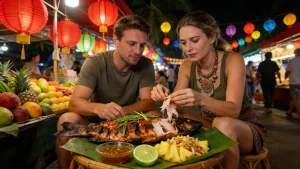
The unwritten rules, the unspoken customs, and the practical survival skills that turn a visitor’s meal into a local’s experience — because the best food in Yunnan rarely comes with an English menu.
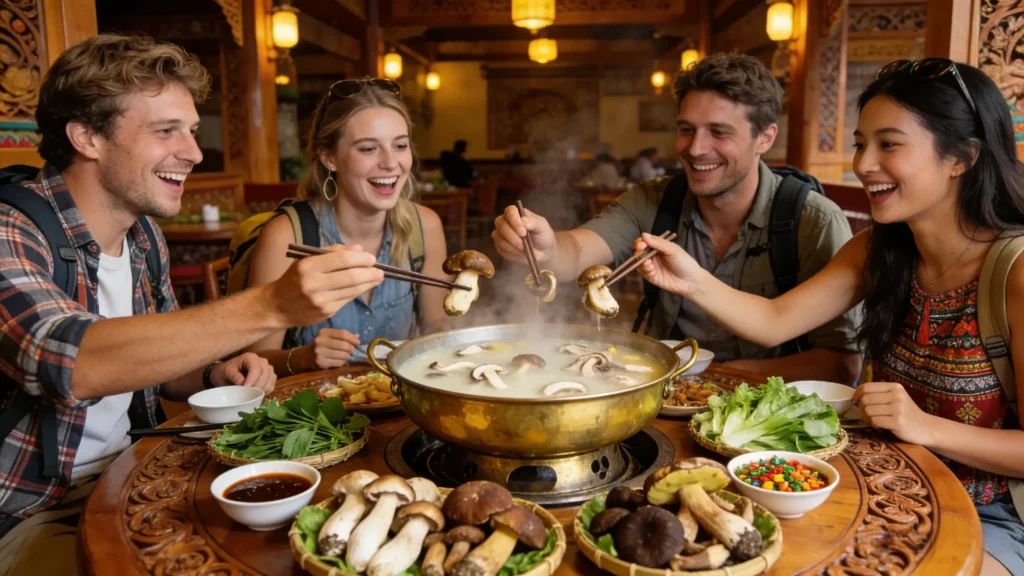
You can eat your way through Yunnan’s tourist-friendly restaurants and have a perfectly good time. But the truly memorable meals — the ones that become travel stories — happen when you venture beyond the English menus and into the places where locals actually eat. The smoky street stall where the cook has been grilling tofu for 30 years. The family restaurant with eight tables and no sign. The morning market where the mushroom vendor lets you taste five varieties before buying. The wedding feast where you’re the only foreigner and someone keeps filling your rice wine cup.
This guide covers the practical knowledge that makes those experiences possible: how Chinese communal dining works, how to navigate a menu without English, how to handle spice, what to do with unfamiliar ingredients, and the cultural customs that will earn you respect at any Yunnan table. For the full Yunnan food picture, see our Yunnan food guide.
How Communal Dining Works
Chinese meals are shared — this is the single most important thing to understand. Unlike Western dining where each person orders their own plate, Chinese meals consist of shared dishes placed in the center of the table. Everyone takes from the communal plates using their own chopsticks (or serving chopsticks when provided). The number of dishes ordered is typically equal to the number of diners plus one soup.
Ordering strategy: Balance flavors and textures. A good Yunnan meal includes: one meat dish, one fish or protein dish, one tofu or egg dish, one or two vegetable dishes, a soup, and rice. Avoid ordering all spicy or all heavy dishes — variety is the Chinese dining aesthetic.
Rice is fundamental. In Yunnan, rice (mǐfàn) is the base of every meal — dishes are accompaniments to rice, not the other way around. Order rice for the table (a big bowl or individual bowls) and use it to balance strong flavors.
The host pays. In Chinese dining culture, one person typically pays the entire bill — and there’s often a friendly fight over who gets to pay. If you’re invited to a meal, your host will pay and will be offended if you insist too strongly on splitting. Accept gracefully, and reciprocate by hosting them next time.
Navigating Menus Without English
Most local restaurants in Yunnan outside major tourist hotels have Chinese-only menus. Strategies:
Use photo menus. Many restaurants have photos of their dishes on the wall or in a picture menu. Point at what looks good.
Use translation apps. Google Translate’s camera function can translate Chinese menus in real-time. Not perfect, but usually gives you enough to make informed choices. Download the offline Chinese language pack before your trip.
Learn key food words. A dozen words will get you through 90% of Yunnan menus:
jī (鸡) = chicken · yú (鱼) = fish · zhūròu (猪肉) = pork · niúròu (牛肉) = beef · dòufu (豆腐) = tofu · mǐxiàn (米线) = rice noodles · chǎo (炒) = stir-fried · kǎo (烤) = grilled · tāng (汤) = soup · là (辣) = spicy · bù là (不辣) = not spicy · sù cài (素菜) = vegetable dish
Point at other tables. See something delicious at the next table? Point and say “wǒ yào nà ge” (I want that one). No Chinese diner will be offended — it’s a universal restaurant move.
Say yes to recommendations. If the server or owner suggests a dish (“tèsè cài” — house specialty), say yes. Restaurant owners recommend what’s freshest and what they’re proudest of — these are almost always the best choices.
Handling Spice
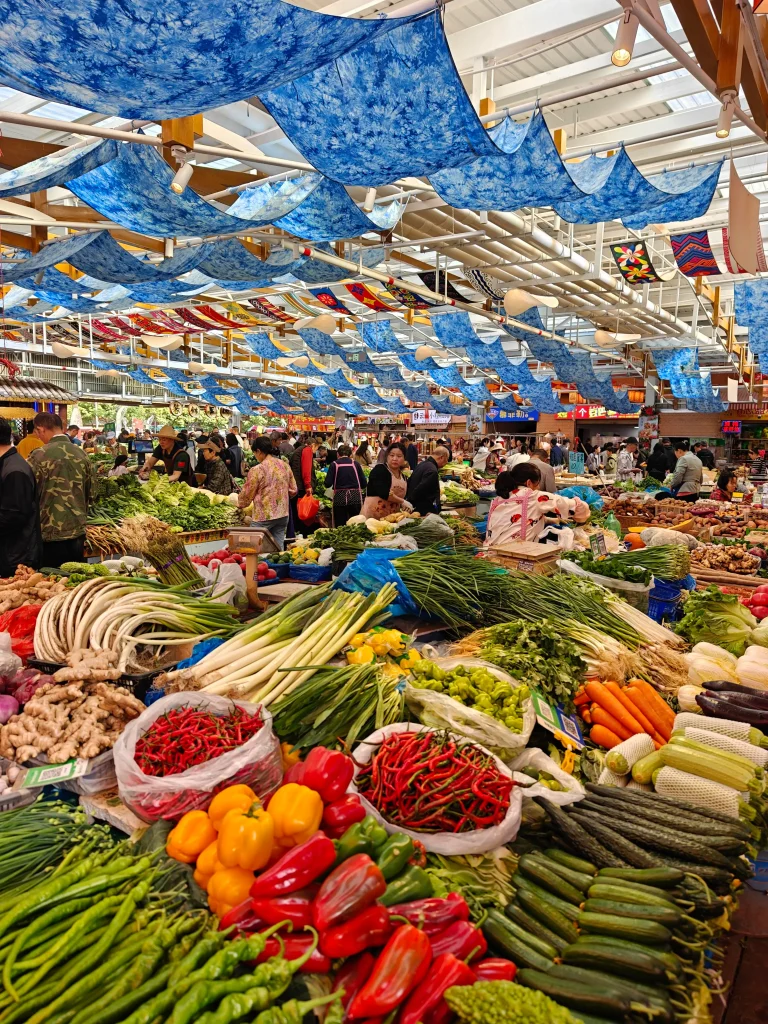
Yunnan food is moderately spicy — not at the Sichuan or Hunan nuclear level, but chili is present in most savory dishes. The spice profile is also different: Yunnan uses dried chili, fresh chili, chili oil, and chili powder, but generally without the numbing Sichuan peppercorn (huā jiāo) that defines Sichuan cuisine. The heat is more straightforward.
If you love spice: Say “duō fàng là jiāo” (add extra chili) and watch the cook’s face light up.
If you’re spice-sensitive: Say “wēi là” (slightly spicy) or “bù là” (not spicy). Most Yunnan restaurants can adjust — many dishes can be prepared mild on request. Order a plain vegetable stir-fry (qīng chǎo shí cài) as a palate reliever.
Cooling tricks: Rice absorbs spice — eat more rice with spicy dishes. Plain soup helps. Sugar or sweetness counteracts heat (hence pineapple rice with spicy Dai food). Cold beer is every Yunnanese person’s spice management tool.
Adventurous Eating: What to Try
Yunnan is one of the best places in China for adventurous eaters — the province’s ethnic diversity produces ingredients and preparations found nowhere else.
Insects: In Xishuangbanna, Dai and Hani communities eat fried bamboo worms, silkworm pupae, crickets, and water bugs. Night market stalls sell them fried and seasoned — crunchy, savory, and genuinely tasty once you get past the visual. Bamboo worms are the easiest entry point.
Raw meat dishes: Several Yunnan minority groups prepare raw pork or raw beef dishes seasoned with herbs and spice. These are culturally significant but carry genuine food-safety risk. If you choose to try them, do so at established restaurants where hygiene is visible.
Wild mushrooms: The ultimate Yunnan food adventure. During season (June–September), mushroom hot pot is the essential experience. Trust the restaurant’s identification and cooking protocols.
Flowers: Yunnan uses flowers extensively in cooking — rose petals in pastries and rushan cheese, chrysanthemum in Crossing the Bridge Noodles, banana flowers in Dai stir-fries, and jasmine in teas. It’s a uniquely Yunnan ingredient category.
Blood and offal: Many Yunnan dishes feature blood sausage, liver, tripe, and other offal — particularly in Naxi and Yi cuisine. If you’re open to it, these are some of the most flavorful dishes in the province.
Food Safety Basics
Drink bottled water. Tap water in Yunnan is not safe to drink. Bottled water is available everywhere (¥1–3). Hot tea and boiled water (kāi shuǐ) are safe.
Eat cooked food. Raw salads are less common in Chinese cuisine, which reduces risk. Cooked-to-order stir-fries, grilled items, and soups are all safe. Street food from busy stalls (high turnover = fresh ingredients) is generally reliable.
Carry basic medicine. Imodium, activated charcoal, and electrolyte powder are sensible precautions. Minor stomach adjustment is common in the first few days of eating in a new country — it usually passes quickly.
Allergies: Communicating allergies in Chinese is essential if you have serious ones. Write “wǒ duì ____ guòmǐn” (I’m allergic to ____) on a card with the specific allergen in Chinese characters. Peanuts (huāshēng), shellfish (hǎixiān), and MSG (wèijīng) are the most relevant common allergens.
Dining Etiquette Quick Guide
Tea pouring: When someone pours you tea, tap two fingers on the table twice as thanks (kòu shǒu lǐ). Pour for others before yourself. Never let someone’s cup sit empty.
Toasting: If toasting with rice wine or beer, clink glasses below the other person’s glass to show respect (especially to elders or hosts). Say “gān bēi” (dry cup) for a full drink or “suí yì” (as you wish) for a sip.
Don’t flip the fish. In some Yunnan communities, flipping a whole fish on the plate is considered bad luck. Use chopsticks to remove the spine and access the bottom half.
Chopstick rules: Don’t stick chopsticks vertically into rice (resembles funeral incense). Don’t point at people with chopsticks. Don’t drum on the table with them. Rest them across the top of your bowl or on the chopstick rest when not eating.
Pace yourself. Chinese meals often have 6–10 dishes arriving over 30–60 minutes. Don’t fill up on the first dish — the best often comes in the middle or end.
For the complete food guides by city — Kunming, Dali, Lijiang, Xishuangbanna — see our dedicated articles. For the full trip planning, our Yunnan itinerary guide includes food-focused route suggestions.
No — but basic food vocabulary and a translation app help enormously. Learn 10–12 key food words, download Google Translate with the offline Chinese pack, and be willing to point at other tables or photo menus. The most rewarding meals often happen at places with no English at all.
Yes, with standard precautions. Drink bottled water, eat cooked food, choose busy stalls with high turnover, and carry basic stomach medicine. Minor digestive adjustment in the first 1–2 days is normal. Serious food-borne illness from restaurant food is rare.
Moderate — less intense than Sichuan or Hunan, but chili is present in most savory dishes. You can request ‘wēi là’ (mild) or ‘bù là’ (no spice) at most restaurants. Dai food in Xishuangbanna tends to be the spiciest regional cuisine; Bai food in Dali is the mildest.
No. Tipping is not customary in China and can cause confusion. The bill is the bill. In rare upscale Western-style restaurants, a service charge may be included, but standard Chinese restaurants — including the best ones — do not expect tips.