For five centuries, two Buddhist kingdoms in Yunnan rivaled the Tang and Song dynasties in power — building pagodas that still stand, forging a multicultural identity that endures, and leaving behind a legacy that shaped every corner of the province.
When most people think of Chinese history, they think of the great dynasties — Tang, Song, Ming, Qing — ruling from Chang’an or Beijing. But for over 500 years, a different power center existed in China’s southwest: the Nanzhao Kingdom (738–902 AD) and its successor, the Dali Kingdom (937–1253 AD). These were not small provincial states. At its peak, Nanzhao controlled an area stretching from modern-day Yunnan through parts of Myanmar, Laos, Vietnam, Guizhou, and Sichuan, fielding armies that twice defeated the Tang Dynasty and once sacked the Burmese capital of Pagan.
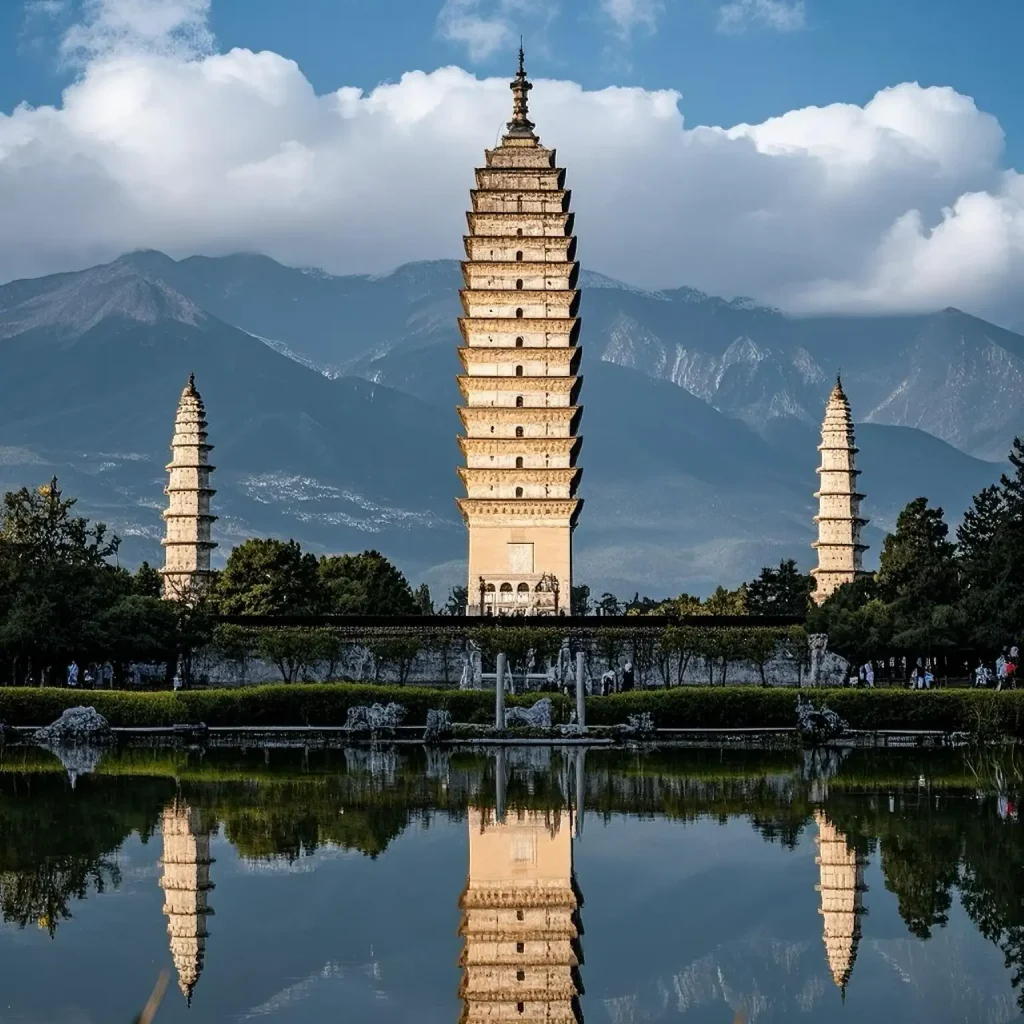
The legacy of these kingdoms is everywhere in modern Yunnan — in the Three Pagodas that have dominated Dali‘s skyline for over a millennium, in the Bai cultural traditions that descend directly from the Dali Kingdom’s court culture, in the Buddhist art that adorns temples from the Cangshan foothills to the Myanmar border. Understanding Nanzhao and Dali transforms a visit to Yunnan from sightseeing into time travel.
This guide tells their story — from the unification of six kingdoms to the Mongol conquest — and shows you where the evidence still stands. For the broader cultural picture, see our Yunnan culture guide and our ethnic minorities guide.
What this guide covers: The rise of Nanzhao → Nanzhao at its peak → The fall & transition → The Dali Kingdom → Buddhism & culture → The Mongol conquest → What survives today → Where to see the legacy → FAQ.
The Rise of Nanzhao (738–902 AD)
Before Nanzhao, the Erhai Lake region was divided among six tribal kingdoms (liù zhào), each controlling a section of the fertile valley between the Cangshan Mountains and the lake. In 738 AD, the leader of the southernmost kingdom — Piluoge of the Mengshe — unified all six through a combination of military conquest, strategic marriages, and (according to legend) the deliberate incineration of rival chiefs at a banquet. Piluoge declared himself king of Nanzhao (“Southern Kingdom”), established his capital at Taihe City near modern Dali, and began building a state that would reshape Southwest Asia.
The ethnic composition of Nanzhao is debated — most historians believe the ruling elite were ancestors of the modern Bai people, with significant Yi, Tibetan, and other minority influences. The kingdom was deliberately multicultural: it absorbed traditions from Chinese, Tibetan, and Southeast Asian civilizations, creating a synthesis that became Nanzhao’s defining characteristic.
Nanzhao at Its Peak
Under kings like Geluofeng and Yimouxun, Nanzhao became a regional superpower. The kingdom’s armies defeated two major Tang Dynasty invasions (in 751 and 754 AD) — inflicting casualties estimated at over 200,000 — forcing Tang China to recognize Nanzhao as an independent state. Later, Nanzhao expanded westward into Burma, sacking the Pyu city-state of Halingyi and the Burmese capital of Pagan. At its maximum extent, Nanzhao controlled territory equivalent to several modern countries.
Nanzhao’s power rested on three foundations: its strategic location controlling the trade routes between China, Tibet, and Southeast Asia (the precursor to the Tea Horse Road); its rice-based agricultural wealth from the Erhai Lake valley; and its military skill, particularly cavalry tactics learned from Tibetan allies.
The kingdom also became a major center of Buddhism — importing monks, texts, and architectural traditions from both the Chinese Mahayana and Indian Esoteric (Tantric) schools. The Three Pagodas, begun during this period, were among the tallest structures in East Asia at the time of their construction.
The Dali Kingdom (937–1253 AD)
After Nanzhao collapsed in 902 AD — weakened by internal power struggles and military overextension — the Erhai Lake region experienced three decades of political chaos. In 937, Duan Siping, a Bai military commander, established the Dali Kingdom (Dàlǐ Guó) and restored stability. The Duan family would rule for the next 316 years — one of the longest dynastic reigns in Chinese history.
A Buddhist Golden Age
If Nanzhao was a warrior state, Dali was a contemplative one. The Dali Kingdom was one of the most devoutly Buddhist states in Asian history. Ten of its twenty-two kings abdicated the throne to become monks — an extraordinary statistic. The kingdom funded the construction of hundreds of temples, monasteries, and pagodas across the Erhai Lake region. Buddhist art flourished: the sculptors of Dali produced some of the finest bronze and gold religious statuary in East Asia, and the painters created a distinctive style blending Chinese, Tibetan, and Indian artistic traditions.
The Dali Kingdom maintained peaceful relations with the Song Dynasty to the east, serving as a crucial intermediary between China and Southeast Asia. Dali merchants controlled the lucrative trade in horses, tea, salt, and exotic goods that flowed through the Tea Horse Road, generating wealth that funded the kingdom’s cultural golden age.
Court Culture & the Bai Legacy
The Dali Kingdom’s court culture — its architecture, arts, religious practices, and hospitality traditions — is the direct ancestor of modern Bai culture. The three-course tea ceremony, the white-walled courtyard architecture, the tie-dye textile tradition, and the elaborate festival calendar that define Bai identity today all trace their refinement to the Dali Kingdom period. Understanding this connection transforms a visit to Xizhou or the Third Month Fair from a tourist activity into a living encounter with a medieval civilization.
The Mongol Conquest (1253)
In 1253, Kublai Khan — grandson of Genghis Khan and future founder of the Yuan Dynasty — led a massive Mongol army across the Tibetan Plateau and into Yunnan. The campaign was a strategic masterstroke: by conquering Dali, the Mongols outflanked the Southern Song Dynasty, which they would subsequently destroy from the south.
The Dali Kingdom’s last king, Duan Xingzhi, surrendered after a brief resistance. In a characteristically pragmatic Mongol move, Kublai didn’t destroy the Duan family — he appointed them as administrators of the region, retaining their local authority under Mongol oversight. The Duan family continued to govern Dali for another century, preserving Bai cultural continuity even under foreign rule.
The Mongol conquest integrated Yunnan into the Chinese empire for the first time — a political shift that defined the province’s trajectory for the next 700 years. But the cultural identity forged by Nanzhao and Dali survived: the Bai people, their Buddhist traditions, their architecture, and their trade networks endured through the Yuan, Ming, and Qing dynasties to the present day.
What Survives Today: Where to See the Legacy
The Three Pagodas of Chongsheng Temple (Dali)
The most iconic surviving monument of the Nanzhao-Dali era. The main pagoda, at 69 meters, was built in 836 AD during the Nanzhao period — making it nearly 1,200 years old and one of the oldest standing structures in Southwest China. The two smaller flanking pagodas were added during the Dali Kingdom. The restored Chongsheng Temple complex behind the pagodas houses a museum with Dali Kingdom bronze statuary and artifacts. Our Dali travel guide covers the full visit details.
Weishan: Nanzhao’s Birthplace
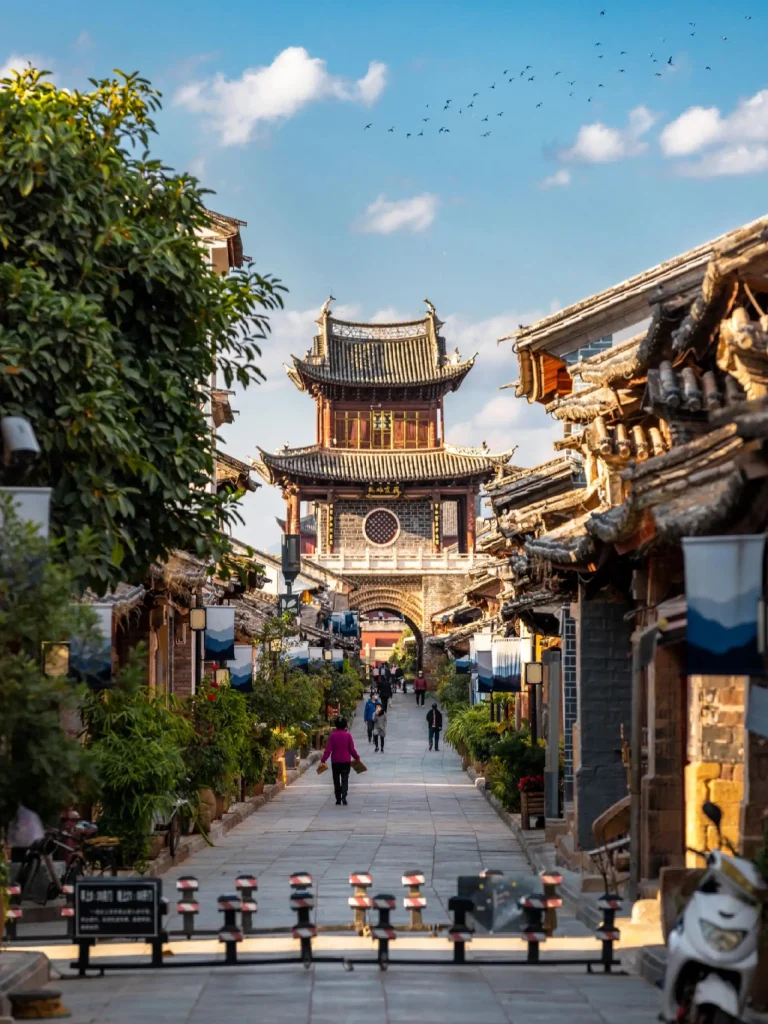
One hour south of Dali, the town of Weishan is where Piluoge unified the six kingdoms and established Nanzhao. The town retains its Ming Dynasty layout — original cobblestone streets, a central drum tower, and Yi/Hui communities that descend from Nanzhao-era populations. Weibaoshan, a Taoist mountain temple complex 10 km from Weishan, has Qing Dynasty murals that incorporate Nanzhao historical imagery.
Taihe City Ruins
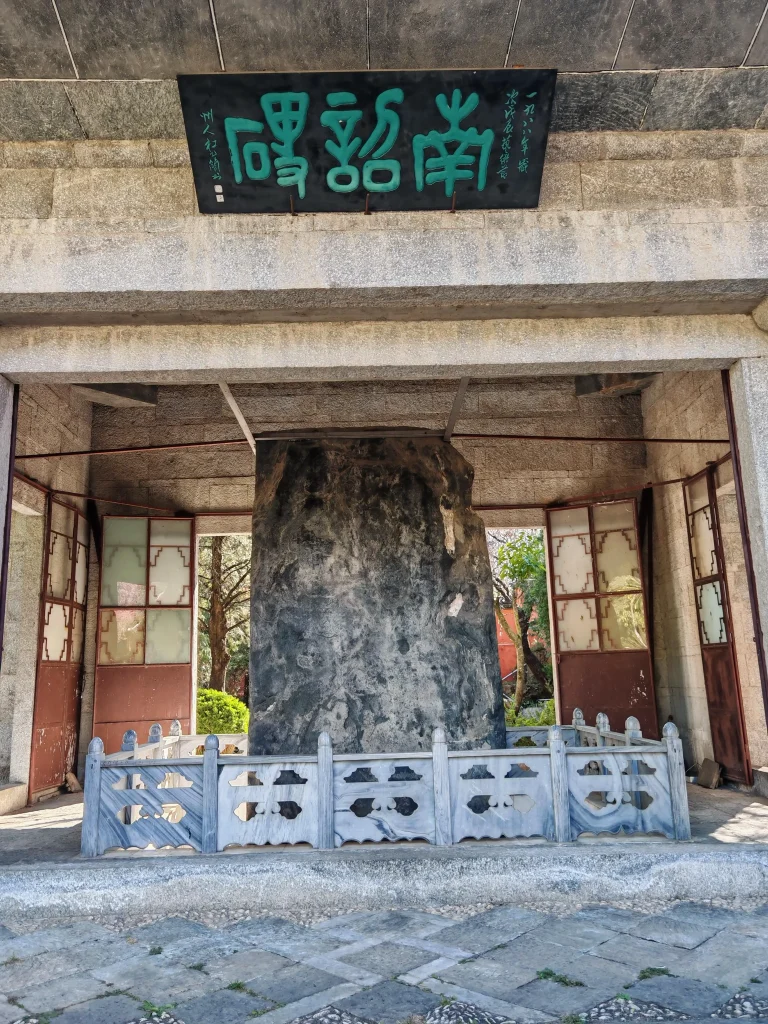
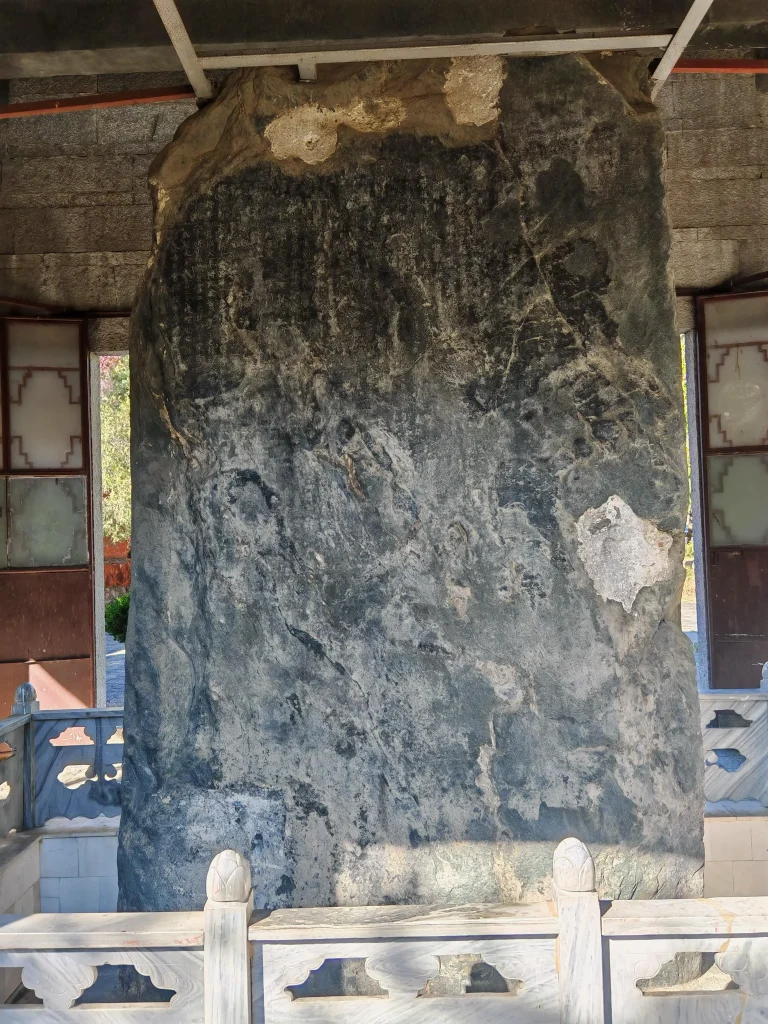
The original Nanzhao capital, located 7 km south of modern Dali Ancient Town along the Erhai Lake shore. Little of the city structure survives above ground, but the Nanzhao Dehua Stele — a massive stone inscription from 766 AD recording the kingdom’s military victories over the Tang Dynasty — stands on a hilltop and is one of the most important historical artifacts in Yunnan.
Shibaoshan Grottoes (near Shaxi)
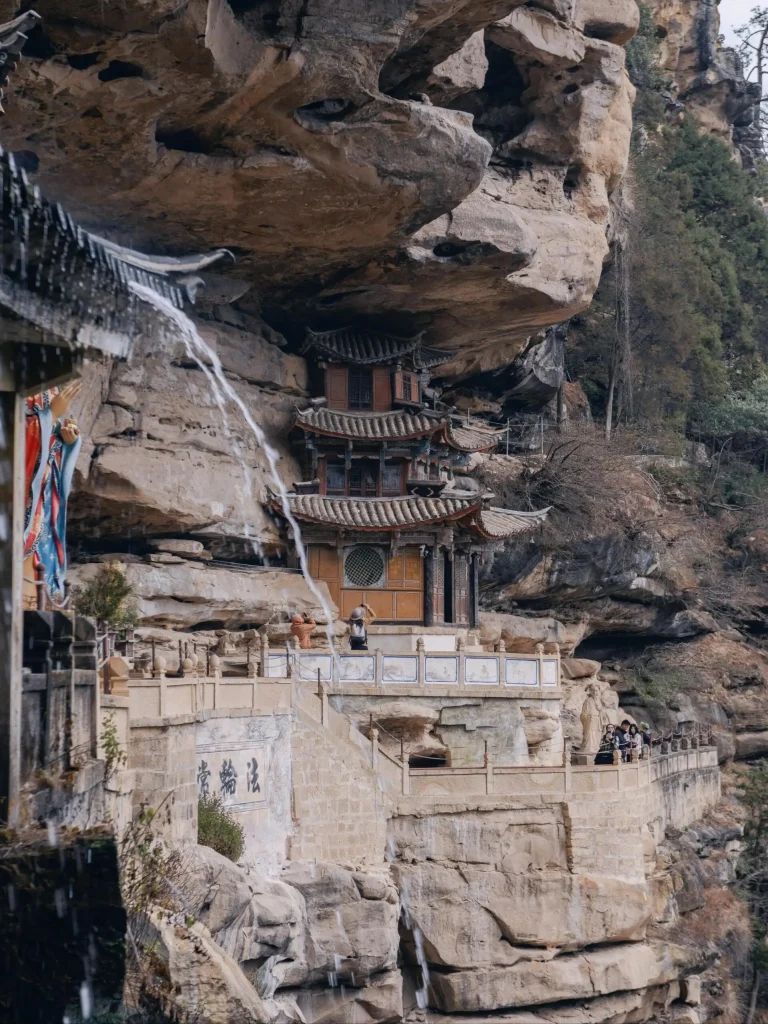
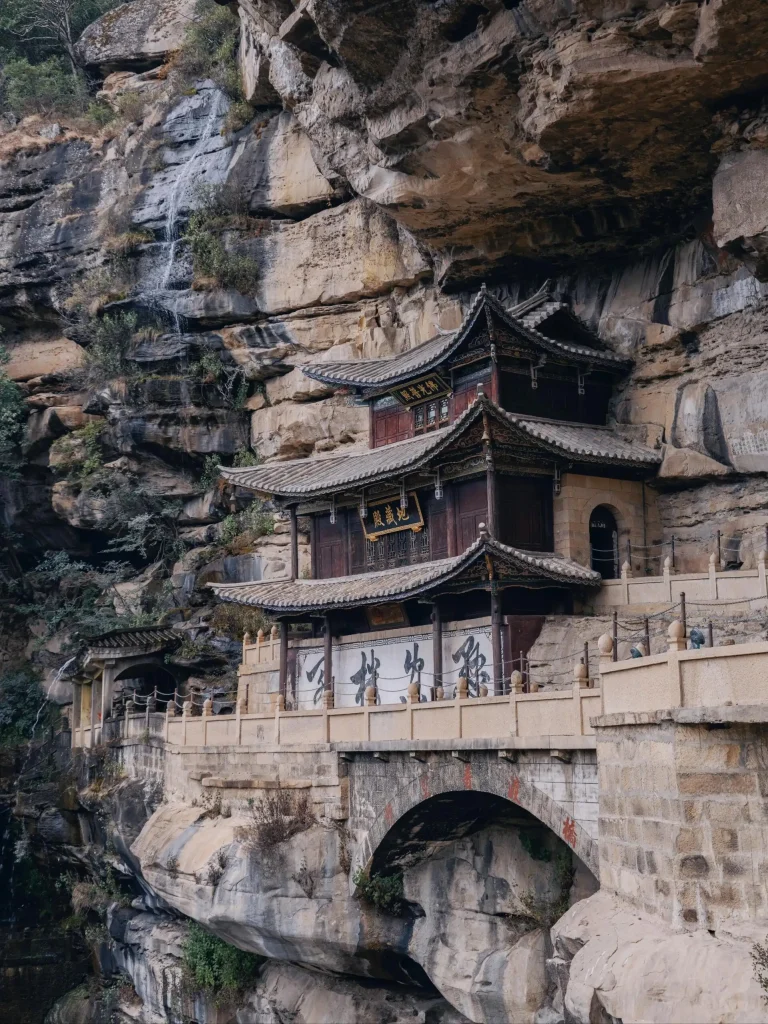
Carved into the cliffs near Shaxi during the Nanzhao period (9th century), these Buddhist rock-cut sculptures — including a striking image of a female deity of fertility — are among the finest surviving examples of Nanzhao-era art. The grottoes are accessible as a day trip from Shaxi and are far less crowded than comparable sites elsewhere in China.
Dali Museum & Provincial Museum (Kunming)
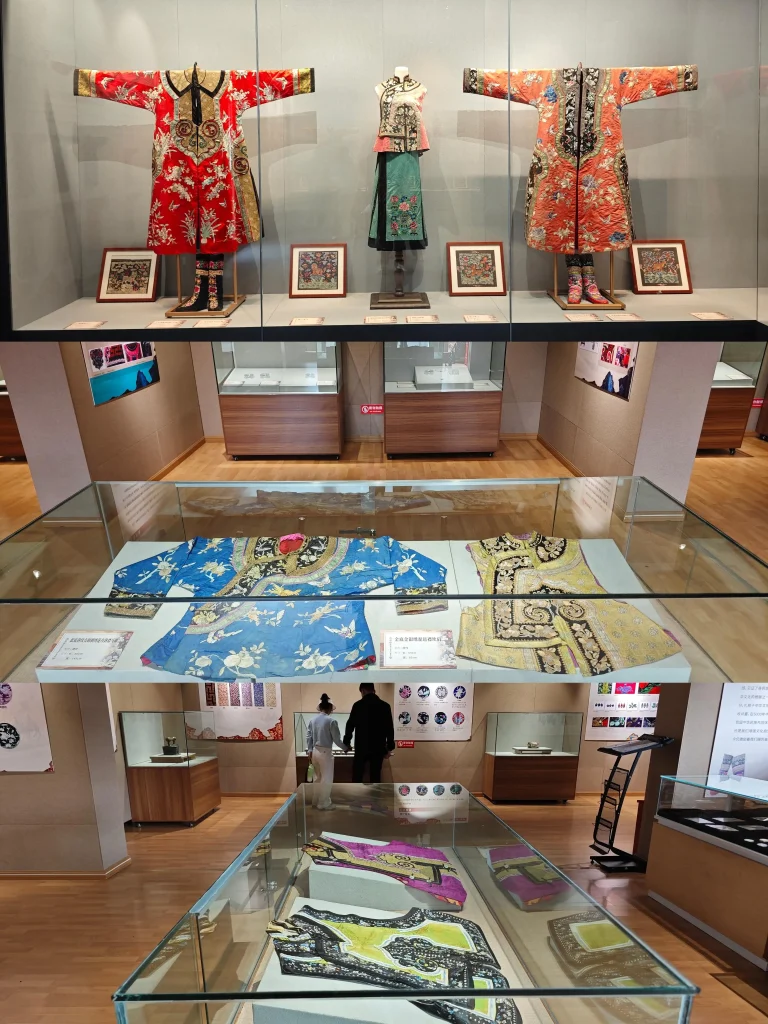
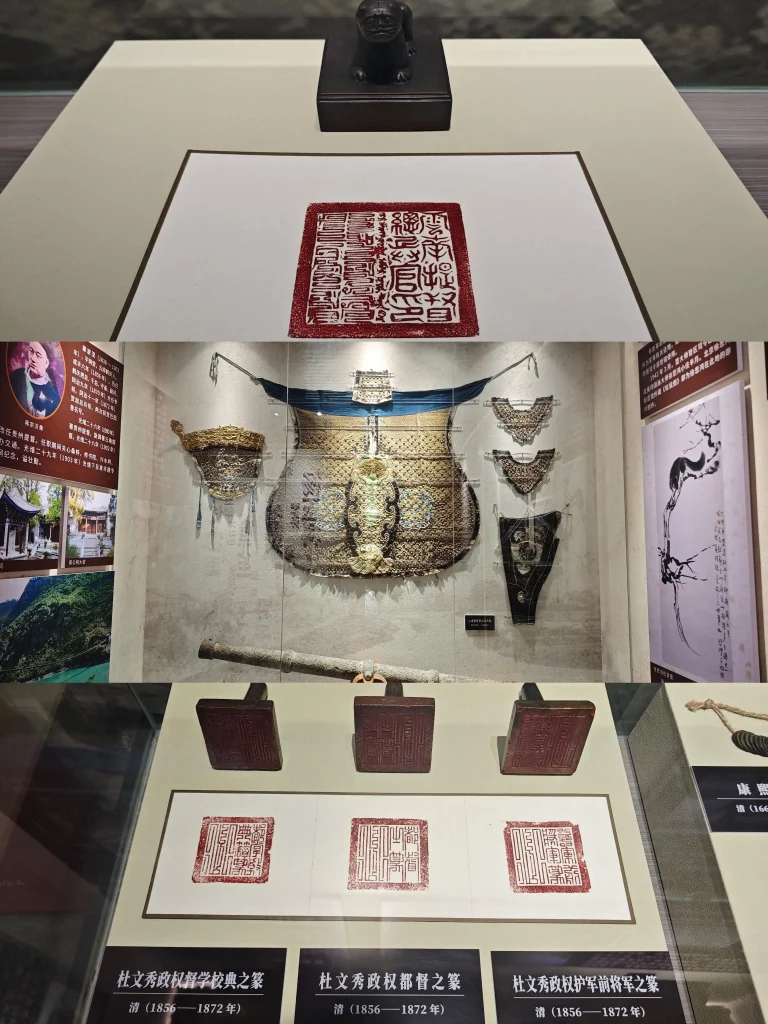
The Dali Museum (in Dali Ancient Town) has a focused collection of Nanzhao-Dali artifacts. The Yunnan Provincial Museum in Kunming has the province’s most comprehensive archaeological collection, including Nanzhao gold and bronze work, Dali Kingdom Buddhist statuary, and artifacts from the Mongol conquest period.
Why This History Matters for Your Trip
Knowing the Nanzhao-Dali story transforms how you experience Yunnan. The Three Pagodas become more than a photo opportunity — they become evidence of a kingdom that rivaled the Tang Dynasty. The Bai three-course tea ceremony becomes a tradition refined in a medieval Buddhist court. The Tea Horse Road towns become waypoints on a network that funded a civilization. The ethnic diversity that makes Yunnan extraordinary becomes the legacy of a multicultural empire that deliberately cultivated it.
For connecting these historical sites into a trip, see our Yunnan itinerary guide — the Kunming → Dali route places you at the heart of the Nanzhao-Dali legacy. For Dali’s food, accommodation, and transport, see our destination guide.
A powerful kingdom based in the Erhai Lake region (modern Dali) that ruled much of Southwest China from 738 to 902 AD. At its peak, Nanzhao controlled territory spanning modern Yunnan, parts of Myanmar, Laos, Vietnam, and Sichuan. It twice defeated Tang Dynasty armies and built the Three Pagodas in Dali, which still stand today.
The successor state to Nanzhao, founded in 937 AD by the Bai military commander Duan Siping. The Dali Kingdom ruled for 316 years until the Mongol conquest in 1253. It was one of Asia’s most devoutly Buddhist states — ten of its twenty-two kings abdicated to become monks. Its court culture is the direct ancestor of modern Bai traditions.
The Three Pagodas of Chongsheng Temple in Dali are the most famous surviving monuments (built 836 AD). Other key sites: the Taihe City ruins and Nanzhao Dehua Stele (7 km south of Dali), Weishan town (Nanzhao’s birthplace, 1 hour south), and the Shibaoshan Grottoes near Shaxi (9th-century Buddhist carvings).
Through a combination of mountain terrain advantage, Tibetan military alliance, and skilled cavalry tactics. In 751 and 754 AD, Tang armies invaded Nanzhao but were decimated in the mountainous approaches to the Erhai Lake valley. Combined Tang casualties from both campaigns exceeded 200,000 soldiers, forcing China to recognize Nanzhao’s independence.
Most historians believe so. The Bai ethnic group is widely considered the primary cultural descendant of the Nanzhao-Dali ruling class, though both kingdoms were multicultural states incorporating Yi, Tibetan, and other populations. Modern Bai traditions — architecture, the three-course tea ceremony, Buddhist practices, festivals — trace their refinement to the Dali Kingdom court.