Where prayer flags snap in the highland wind, yak herds drift across golden meadows, and a monastery the size of a small city rises above the clouds at 3,300 meters.

For most of its history, this remote highland town in Yunnan’s far northwest was called Zhongdian — a quiet Tibetan settlement at 3,300 meters where monks chanted at dawn, yak butter tea simmered in every kitchen, and the outside world felt very far away. Then, in 2001, the county government renamed it Shangri-La, claiming the town was the real-life inspiration for James Hilton’s 1933 novel Lost Horizon — and tourism changed everything.
But here’s what the marketing doesn’t tell you: it doesn’t matter whether this is the “real” Shangri-La. What matters is that the Tibetan culture here is genuine, the landscapes are staggering, and the experience of standing in a monastery courtyard at 3,380 meters — prayer wheels spinning, incense smoke curling into a sky so blue it hurts — is one of the most powerful moments you’ll have in China.
Shangri-La is the endpoint of one of Yunnan’s great journeys: the cultural climb from the Naxi lowlands of Lijiang through the drama of Tiger Leaping Gorge to the Tibetan plateau. This guide will help you plan every step. For the big-picture planning, our ultimate Yunnan travel guide covers logistics, and our top things to do in Yunnan puts Shangri-La in context with the rest of the province.
What this guide covers: Dukezong Old Town → Songzanlin Monastery → Pudacuo National Park → Napa Lake → Meili Snow Mountain → Tibetan culture → Highland cuisine → Getting there → Altitude advice → Practical tips.
Dukezong Old Town: The Heart of Shangri-La
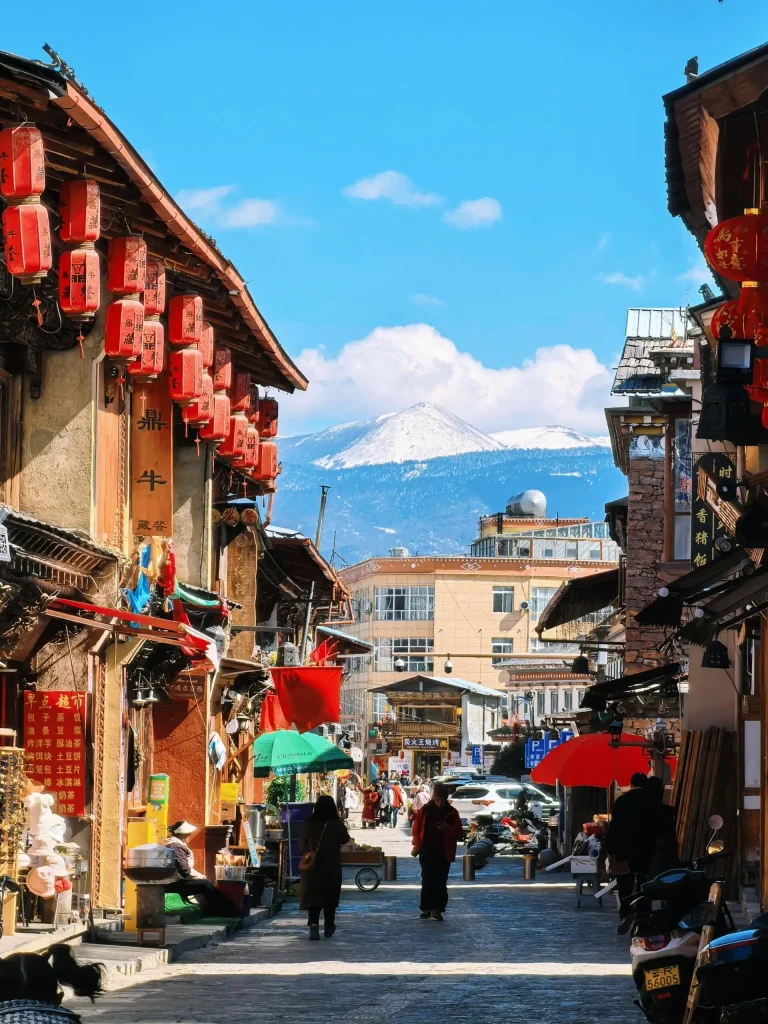
Dukezong — meaning “moonlight city” in Tibetan — is one of the oldest and best-preserved Tibetan towns in Yunnan. Its cobblestone streets, hand-built from local stone, have been walked for 1,300 years. Tibetan-style wooden houses, many with brightly painted window frames and rooftop prayer flags, line narrow lanes that wind up toward the hilltop park.
The old town suffered a devastating fire in 2014 that destroyed a third of its historic buildings, but the reconstruction — using traditional materials and techniques — has been thoughtfully done, and Dukezong today feels authentic rather than artificial.
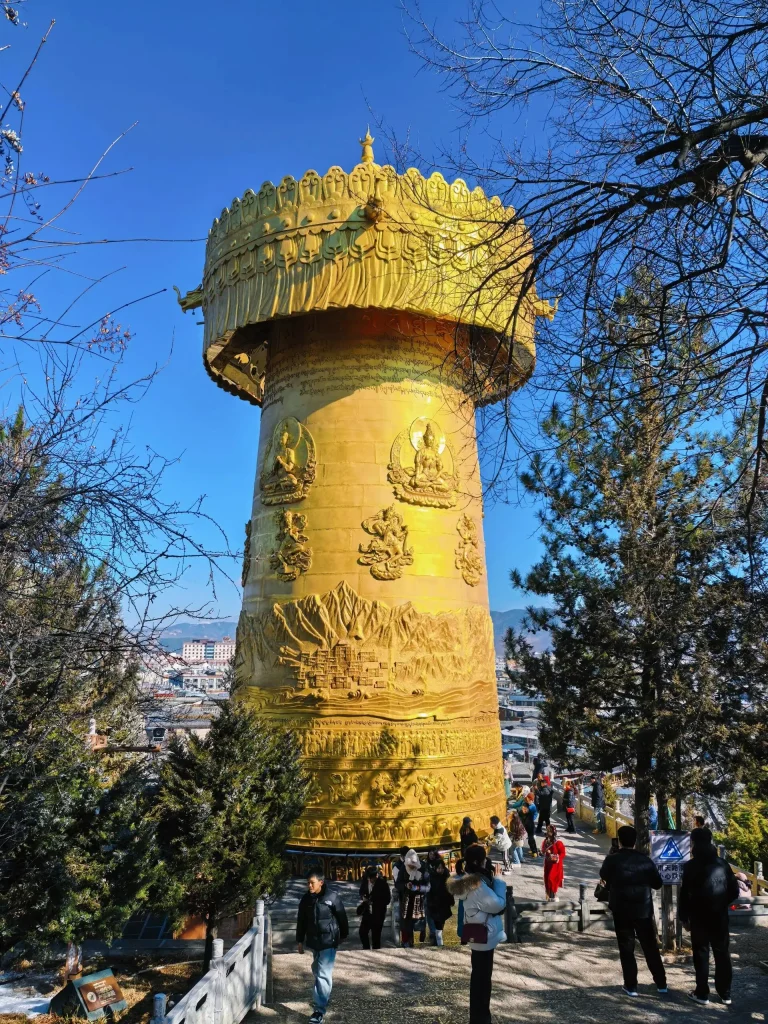
Key sights: The Giant Prayer Wheel on Guishan Hill — a 21-meter, 60-ton copper cylinder packed with Buddhist scriptures. It takes at least four people to spin it (join a group of visitors and push together; three full turns is considered auspicious). The hilltop offers the best panoramic view of the old town and surrounding mountains. At the base of the hill, small Tibetan teahouses serve butter tea and tsampa — your first taste of highland cuisine.
Evening in Dukezong is magical: Tibetan families and monks gather in the central square for communal dancing (guozhuang), forming a large circle and stepping in rhythmic unison to traditional music. Visitors are warmly welcome to join. It happens spontaneously most evenings — no tickets, no stage, just community.
Songzanlin Monastery: Yunnan’s Little Potala Palace
Five kilometers north of town, Songzanlin Monastery is the largest Tibetan Buddhist monastery in Yunnan — and one of the most visually dramatic religious sites in all of China. Built in 1679 by the Fifth Dalai Lama, the monastery complex rises in terraced golden-roofed halls up a hillside, housing around 700 monks who live, study, and practice here year-round.
The monastery is active and atmospheric: monks debate scripture in courtyards, butter lamps flicker in dark halls lined with thangka paintings, and the deep resonance of chanting horns carries across the valley at dawn. The main assembly hall, with its massive golden Buddha and walls painted with intricate murals, is the spiritual centerpiece.
Visiting tips: Admission is ¥90 (includes shuttle bus from the gate to the monastery). Dress modestly (cover shoulders and knees). Walk clockwise around all religious structures. Photography is usually permitted in courtyards but not inside the main halls — always ask first. Hire a local Tibetan guide (available at the entrance) for deeper context on the monastery’s history and daily life.
For the full story of Tibetan culture in Shangri-La — the religion, the daily rituals, the festivals, and how to engage respectfully — read our detailed cultural guide.
Pudacuo National Park
Twenty-two kilometers east of town, Pudacuo is China’s first true national park — a protected area of alpine lakes, virgin forest, and highland meadows that showcases the biodiversity of the Yunnan-Tibet transition zone. The park covers 1,300 square kilometers but visitor access focuses on two main areas connected by shuttle bus.
Shudu Lake: A high-altitude lake surrounded by spruce forest where the water is so clear you can see the bottom at 6 meters depth. A 3.3-kilometer boardwalk circles the lake — an easy, flat walk that takes about an hour and offers some of the most photogenic scenery in Shangri-La.
Bita Lake: A smaller, more intimate alpine lake with a 4.2-kilometer boardwalk trail through old-growth forest. In autumn, the surrounding hillsides explode in gold and crimson. Wildlife — including endangered golden monkeys and Yunnan black-necked cranes — inhabits the park, though sightings require patience and luck.
Practical details: Entry fee ¥100 plus ¥70 for the mandatory shuttle bus. The park sits at 3,500–3,800 meters — higher than Shangri-La town — so take it easy, bring a warm layer even in summer, and watch for signs of altitude sickness. Best visited in the morning when crowds are thinner and light is best.
Napa Lake & the Highland Grasslands
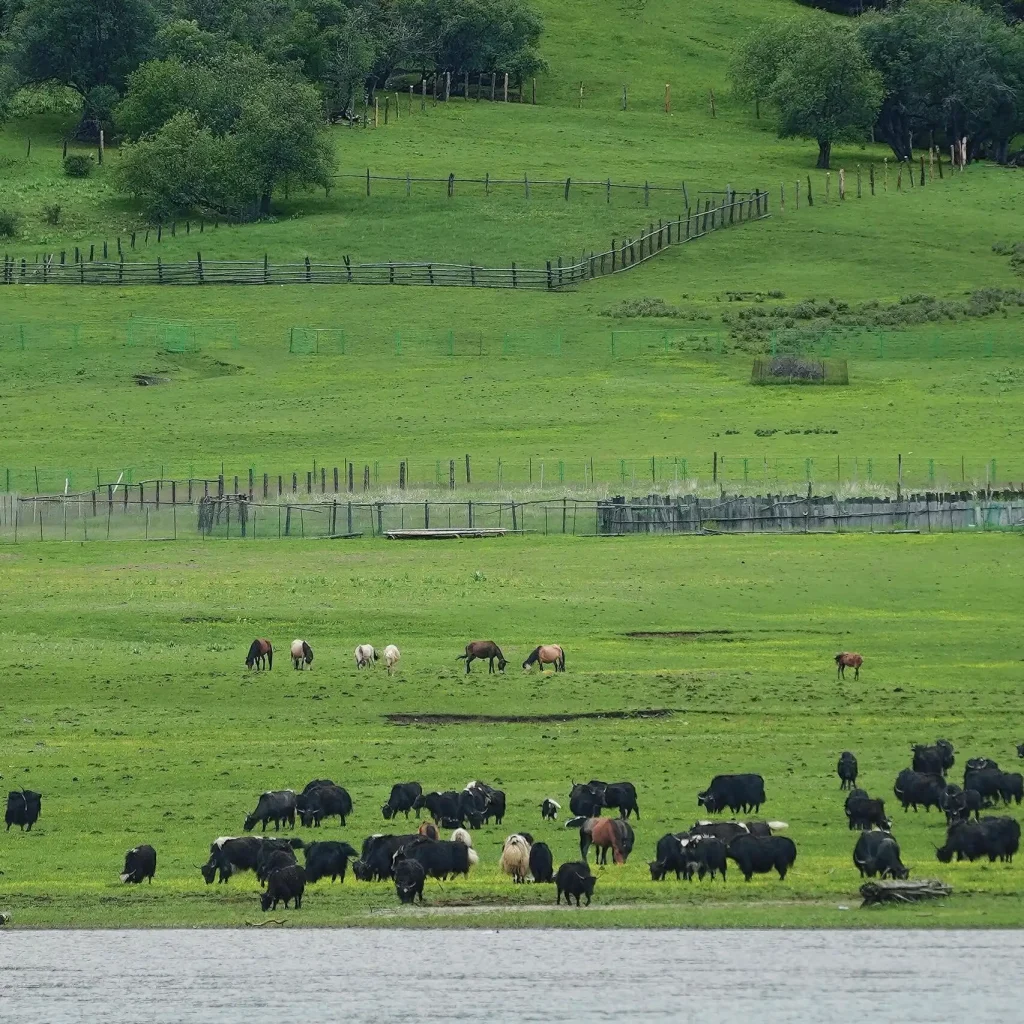
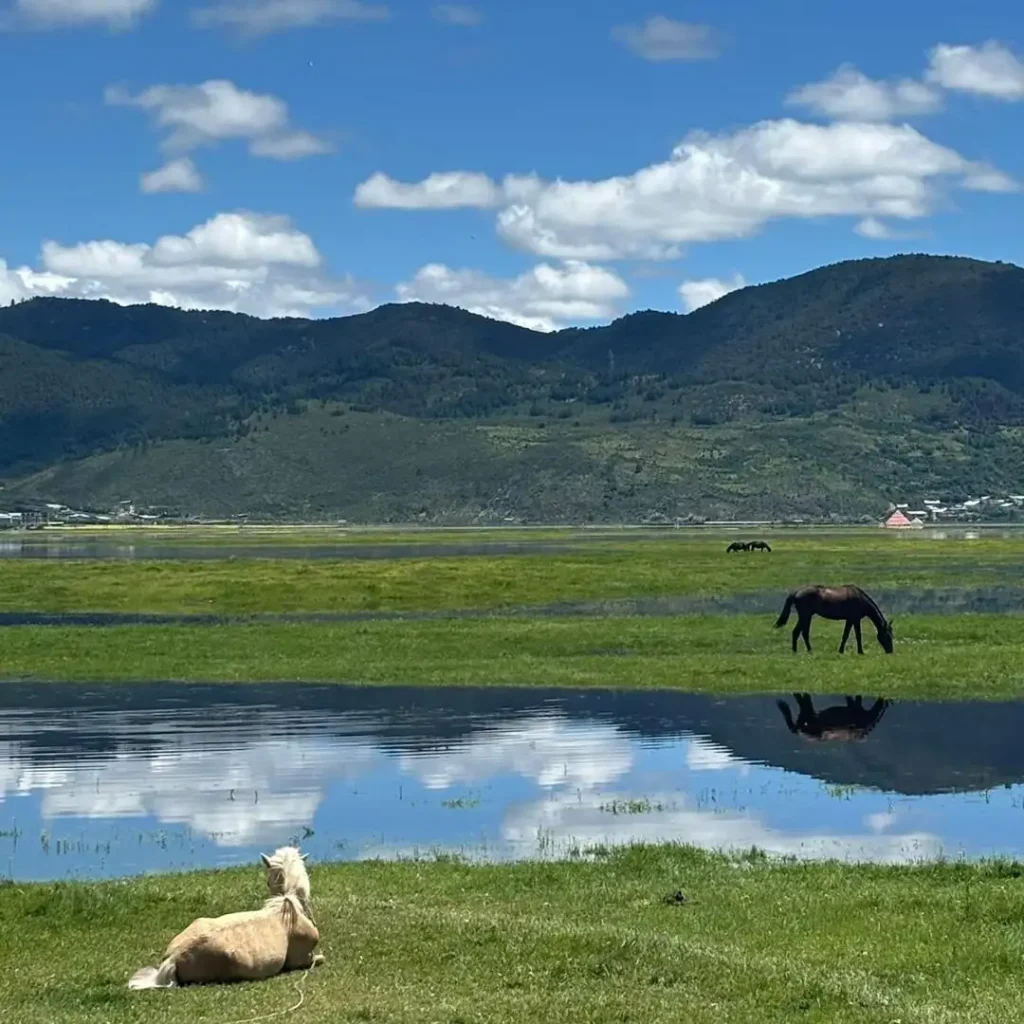
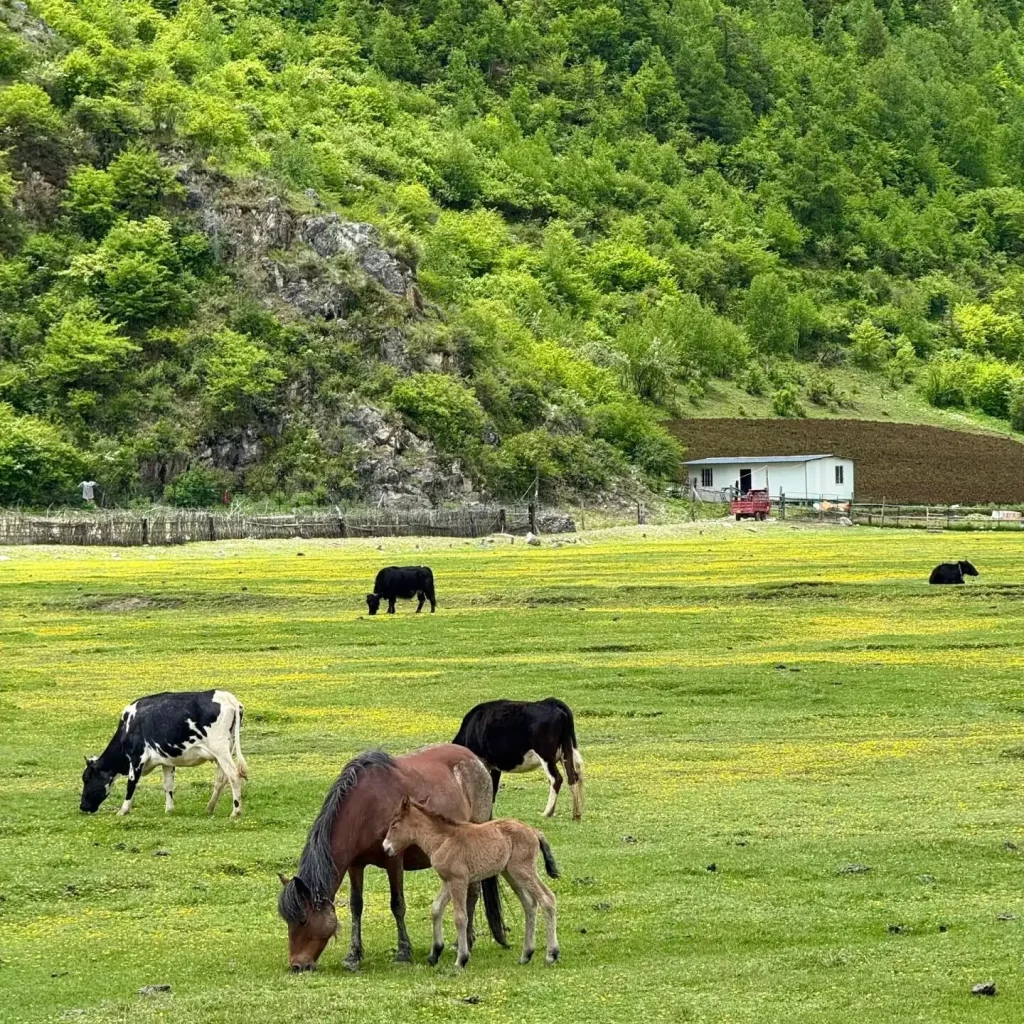
Eight kilometers southwest of Shangri-La, Napa Lake (Nàpà Hǎi) is a seasonal highland wetland that transforms dramatically with the calendar. In summer and autumn, it’s a vast green meadow dotted with grazing yak and wildflowers. In winter, it fills with water and becomes a crucial wintering ground for black-necked cranes and migratory birds.
The area around Napa Lake is some of the most accessible Tibetan pastoral landscape in Yunnan. Rent a bike (available in town) or hire a car, and ride along the dirt roads that circle the lake, stopping at small Tibetan villages where families will often invite you in for butter tea. The grasslands at sunset — golden light on green meadows with snow peaks behind — are quintessential highland Yunnan.
Side Trip: Meili Snow Mountain & Feilai Temple
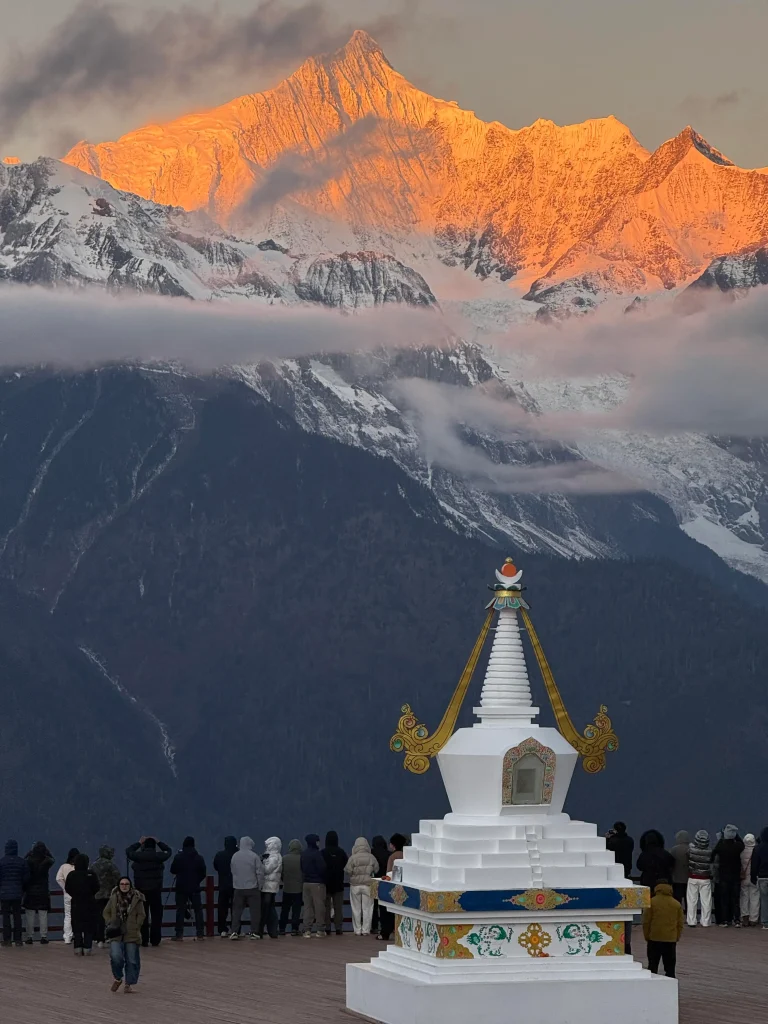
For travelers with extra time, the journey northwest from Shangri-La to Deqin — and the sacred Meili Snow Mountain (Kawagebo, 6,740m) — is one of Yunnan’s most dramatic drives. The road crosses the 4,292-meter Baima Snow Mountain Pass before descending to the Mekong River and climbing again to the viewing point at Feilai Temple.
Meili’s main peak, Kawagebo, is considered sacred by Tibetan Buddhists and has never been summitted — all climbing attempts have been banned after a deadly avalanche in 1991 that killed 17 climbers. The mountain appears from behind clouds on its own schedule; locals say that seeing Kawagebo’s peak is a sign of spiritual merit. The “sunrise gold” moment — when the first light hits the snow peak and turns it blazing gold against a dark sky — is, for many travelers, the single most beautiful sight in all of Yunnan.
Logistics: Deqin is 4–5 hours by bus from Shangri-La. Budget 2 nights: one in Feilai Temple village (facing the mountain) for the sunrise, and one in Deqin or Yubeng village for trekking.

Highland Cuisine: What to Eat in Shangri-La
At 3,300 meters, the food turns Tibetan — denser, richer, and built for altitude. For the broader picture, our Yunnan food guide covers the full province.
Yak Meat: The highland staple — served dried as jerky-like strips, stewed in hot pots, stir-fried with wild vegetables, or as hearty yak-meat dumplings. The flavor is richer and more complex than beef. Yak hot pot restaurants in Dukezong Old Town are the best introduction.
Butter Tea (Sū Yóu Chá): Yak butter, salt, and tea leaves churned together into a rich, savory brew. Tibetans drink it all day — it’s fuel for high-altitude life. First-timers usually find it challenging; by the third cup, many are converts. Every Tibetan household will offer you a cup.
Tsampa: Roasted barley flour mixed with butter tea into a dough-like ball. The staple carbohydrate of the Tibetan highlands — simple, filling, and deeply tied to Tibetan identity.
Highland Mushrooms: The forests around Shangri-La produce excellent matsutake (sōngróng) — a prized mushroom that Japanese buyers fly in to purchase directly. During season (July–September), local restaurants serve it fresh.
Pu’er Tea: Though Pu’er grows in the southern lowlands, it was historically traded through this region on the Tea Horse Road — and Shangri-La’s teahouses brew excellent aged Pu’er as a connection to that history.
Getting to Shangri-La
From Lijiang: Bus (4 hours, ~70 yuan) through stunning mountain scenery including views of Tiger Leaping Gorge territory. The road climbs from 2,400m to 3,300m — a dramatic altitude transition. Alternatively, fly (45 minutes).
From Kunming: Flight (1 hour, the most practical option) to Shangri-La Diqing Airport. Flights are frequent but can be disrupted by weather in winter.
Getting around: Dukezong Old Town is walkable. Songzanlin Monastery and Pudacuo National Park are best reached by taxi, Didi, or organized tour. Napa Lake is cycling distance. The Deqin/Meili Snow Mountain trip requires a bus or hired car.
For multi-city route planning, check our Yunnan itinerary guide — the classic Kunming → Dali → Lijiang → Shangri-La route is Yunnan’s most popular circuit.
Altitude & Practical Tips
Altitude is the main challenge. Shangri-La sits at 3,300 meters, and Pudacuo National Park reaches 3,800 meters. Most travelers arriving from Lijiang (2,400m) will notice shortness of breath, possible headaches, and disturbed sleep for the first 24 hours. Tips: take it very easy on Day 1 (no strenuous activity), drink plenty of water, avoid alcohol, eat lightly, and consider buying an oxygen canister from a pharmacy (about ¥10). If symptoms worsen — severe headache, nausea, confusion — descend immediately.
Best time to visit: May–June and September–October for the best weather and visibility. Summer (July–August) is rainy season — lush but cloudy. Winter (November–March) is cold (down to -10°C at night) but dry with clear mountain views and fewer tourists. The Tibetan New Year (Losar) in February or March is the best time for cultural immersion.
How many days: 2–3 days in Shangri-La proper. Day 1: Dukezong Old Town + Songzanlin Monastery. Day 2: Pudacuo National Park. Optional Day 3: Napa Lake or Meili Snow Mountain side trip (add 2 days for Meili). For the cultural context that will make every temple visit more meaningful, read our Yunnan culture guide before you arrive.
What to pack: Warm layers (even in summer, evenings are cold at 3,300m), sunscreen (UV is intense at altitude), a good jacket, comfortable walking shoes, and a power bank (cold weather drains phone batteries faster).
At 3,300 meters, mild symptoms are common for the first 24 hours — shortness of breath, headache, slight fatigue. Serious altitude sickness is uncommon if you take it easy on Day 1 and stay hydrated. If you’re coming from Lijiang (2,400m), the transition is manageable. If flying directly from a low-altitude city, be extra cautious. Oxygen canisters are available at pharmacies for about ¥10.
It’s a tourism rebranding. The town was originally called Zhongdian and was renamed in 2001 to attract visitors. The novel’s Shangri-La is fictional. That said, the Tibetan culture, the monastery, and the highland landscapes are genuinely spectacular and worth the visit regardless of the name.
Bus (4 hours, ~¥70, spectacular mountain scenery) or flight (45 minutes). The bus is the more popular option and follows a dramatic route through mountain passes. Buses depart frequently from Lijiang Bus Station.
Winter nights can drop to -10°C. Summer days are pleasant (15–25°C) but evenings are cool (5–10°C). Year-round, pack warm layers — this is highland Yunnan. Heated accommodations are standard in winter.
Yes — and you should. The bus from Lijiang to Shangri-La passes near Tiger Leaping Gorge. Many travelers hike the gorge over 2 days, then continue to Shangri-La by bus. It’s one of Yunnan’s best multi-day routes.