A 270-million-year-old labyrinth of razor-sharp limestone pillars, where geology created something that looks like a forest planted by giants — and where a Sani girl turned to stone still guards the entrance.

Eighty kilometers southeast of Kunming, the Stone Forest — Shilin in Chinese — is one of the most extraordinary geological formations on Earth. Imagine a forest, except instead of trees, the “trunks” are 30-meter-tall pillars of limestone, razor-edged, blade-thin, packed so tightly together that walking among them feels like navigating a maze built by a civilization of stone giants. The formations are 270 million years old — the remains of an ancient seabed pushed upward by tectonic forces and sculpted over eons by wind and water into the surreal landscape you see today.
UNESCO inscribed the Stone Forest as part of the South China Karst World Heritage Site in 2007, recognizing it as “one of the most spectacular examples of karst landforms anywhere in the world.” It’s Kunming’s most popular day trip, Yunnan’s most visited natural attraction, and a place that genuinely delivers on its extraordinary reputation — even after you’ve seen the photos.
This guide covers everything you need for a great visit: the different sections of the park, how to avoid crowds, the Sani culture that gives the stone its stories, and the practical logistics that make the difference. For the big-picture planning, see our ultimate Yunnan travel guide and our Kunming travel guide for day trip logistics.
What this guide covers: What makes the Stone Forest special → Major Stone Forest → Minor Stone Forest → Naigu Stone Forest → The Ashima legend → Sani culture → Practical tips → Getting there → When to visit → FAQ.
The Major Stone Forest (Dà Shílín)
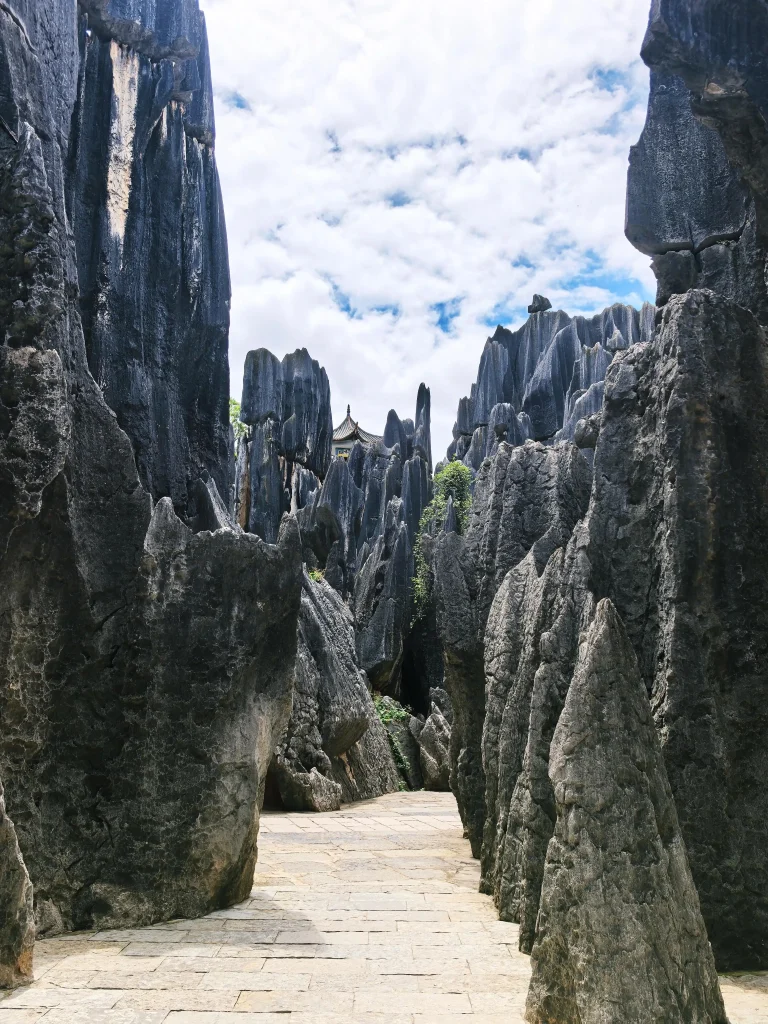
The Major Stone Forest is the main event — the section you’ve seen in every photograph, and the one that earns the UNESCO designation. A network of paved paths winds through a dense concentration of limestone pillars, some towering 30 meters above your head, others forming narrow corridors barely wide enough to squeeze through.
The experience is genuinely otherworldly. Sunlight filters between the pillars in shifting columns. The paths fork and reconnect in a maze-like pattern that rewards wandering without a strict route. Every few minutes, a new formation appears that looks like something recognizable — an elephant, a mushroom, a sword, a seated monk. The Chinese love naming rocks, and the Stone Forest’s formations have been given hundreds of poetic labels over the centuries.
The most famous formation is the Ashima Stone — a slender pillar that, from the right angle, resembles a Sani woman carrying a basket on her back. The legend of Ashima (more on that below) is the emotional heart of the Stone Forest, and the pillar bearing her name has become the park’s symbol.
Tip: The Major Stone Forest is the most visited section and gets crowded, especially during Chinese holidays and between 10 AM and 2 PM when tour groups arrive. Visit early morning (before 9 AM) or late afternoon (after 3 PM) for the best experience. The light is also more dramatic at these times, with longer shadows that emphasize the pillars’ shapes.
The Minor Stone Forest (Xiǎo Shílín)
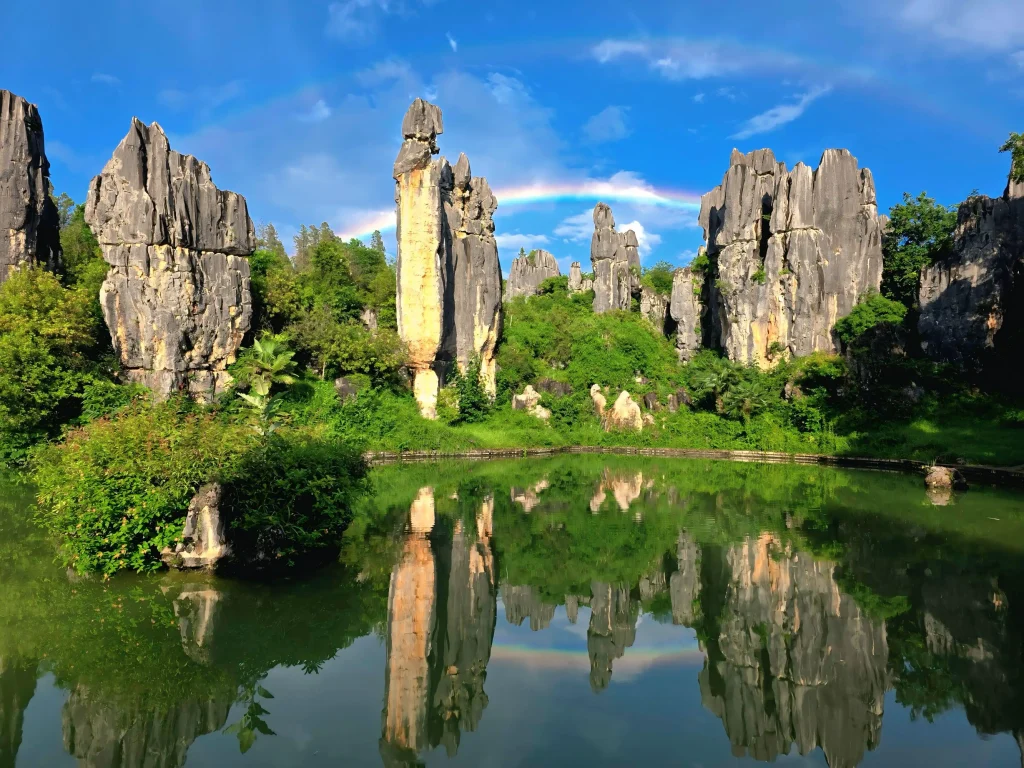
Adjacent to the Major Stone Forest but far less crowded, the Minor Stone Forest offers a softer, more pastoral version of the karst landscape. The pillars here are shorter, more widely spaced, and interspersed with grass and wildflowers — creating a landscape that feels more like a surreal garden than a stone labyrinth.
The Minor Stone Forest is where the Sani people hold their annual Torch Festival celebrations — Yi people from surrounding villages converge here in late July or early August for three days of fire worship, wrestling, bullfighting, and bonfire dancing. If your visit overlaps with the Torch Festival, the Minor Stone Forest transforms from a quiet geological garden into one of Yunnan’s most spectacular cultural events.
Even without the festival, the Minor Stone Forest is worth an hour’s walk. The contrast with the Major Stone Forest — intimate rather than overwhelming, green rather than gray — provides a welcome change of pace.
Naigu Stone Forest: The Untouched Alternative
Eight kilometers northeast of the main park, the Naigu Stone Forest is the Stone Forest experience for visitors who want to avoid crowds entirely. Naigu is larger in area than the main park but receives a fraction of the visitors — some days you may have entire sections to yourself.
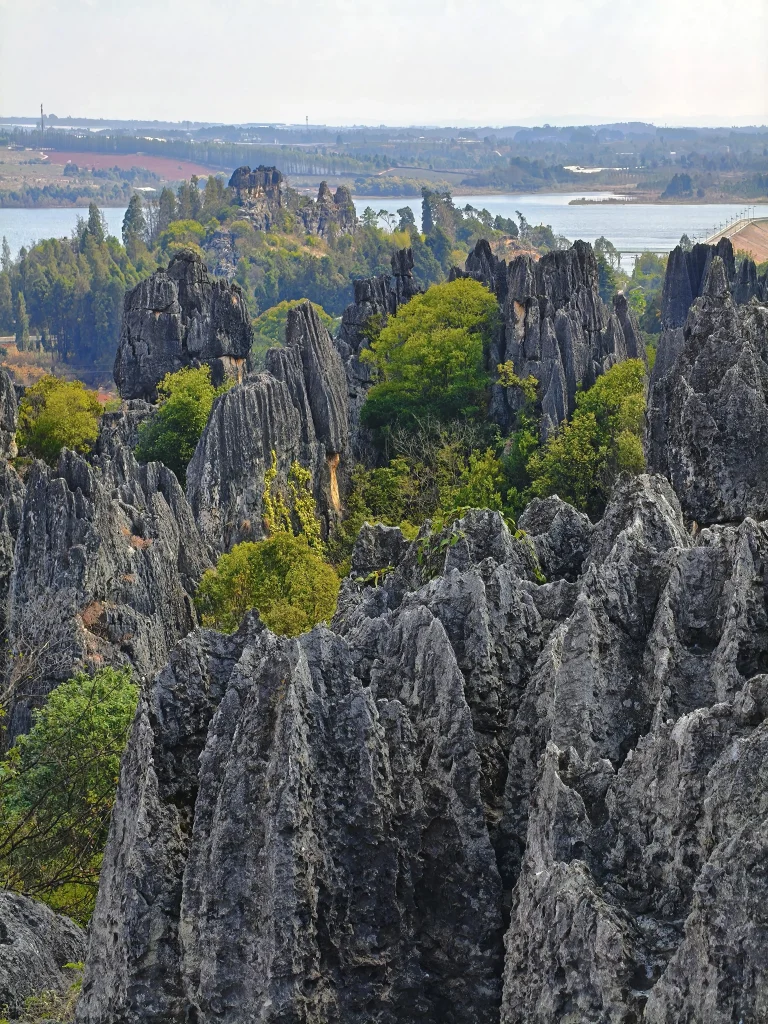
The formations at Naigu are darker in color (black-gray limestone rather than the lighter gray of the main park) and more weathered, with deeper grooves and more dramatic erosion patterns. The park is less developed — fewer paved paths, fewer railings, more of a wild, unmanicured feel. It’s the better choice for visitors who want a more adventurous, less theme-park experience.
Practical note: Naigu has a separate entrance fee (¥25) and is not included in the main Stone Forest ticket. Access is by taxi or hired car from the main park (15 minutes). Combine both for the fullest Stone Forest experience.
The Legend of Ashima & Sani Culture
The Stone Forest isn’t just a geological wonder — it’s a cultural landscape, deeply entwined with the Sani people, a branch of the Yi ethnic group who have lived in the surrounding villages for centuries.
The defining story is the legend of Ashima — a beautiful, brave Sani girl who was kidnapped by a wealthy landlord’s son and, despite her beloved’s heroic rescue attempt, was ultimately turned to stone by a vindictive flood. The Ashima Stone pillar in the Major Stone Forest is said to be her petrified form, standing eternal watch over the landscape she loved.
The legend is far more than a tourist story. Ashima represents resistance, courage, and the Sani ideal of love conquering power. It’s been adapted into film, opera, poetry, and song, and remains a living cultural reference for the Sani people. In the Stone Forest park, Sani guides in traditional embroidered dress tell the story at the Ashima Stone — and their versions, passed down orally through generations, have emotional layers that the printed placards miss.
The Sani people also bring the Stone Forest alive through their year-round presence: Sani women in traditional dress (tall embroidered headdresses and colorful layered jackets) work as guides, sell handicrafts, and perform traditional music and dance. Hiring a Sani guide (available at the entrance, ¥100–200) adds invaluable cultural context to a visit that might otherwise be purely geological.
For the broader context of Yunnan’s 25 ethnic minority groups and how the Sani/Yi traditions fit into the province’s cultural mosaic, see our Yunnan culture guide.


Getting to the Stone Forest
From Kunming:
Tourist bus: Direct buses from Kunming East Bus Station to Stone Forest (1.5 hours, ¥34). Buses run frequently starting at 7:30 AM. The most straightforward option.
High-speed train + shuttle: Take the high-speed train from Kunming South Station to Shilin Station (20 minutes, ¥22), then a shuttle bus or taxi to the park entrance (15 minutes). The fastest but involves a transfer.
Day tour: Many Kunming hotels and travel agencies offer Stone Forest day tours (¥200–400 including transport and guide). Convenient but you’ll be on someone else’s schedule.
Private car/Didi: About 1.5 hours from Kunming city center. Most flexible option, especially if combining with Naigu Stone Forest or wanting to stay past the tour-bus departure times.
Entrance fees: Main Stone Forest park ¥130 (includes shuttle bus within the park). Naigu Stone Forest ¥25 (separate entrance). Audio guide rental ¥30.
Practical Tips for Visiting
How long to spend: 3–4 hours for the Major and Minor Stone Forests. Add 1.5 hours for Naigu. A full day from Kunming (departing by 8 AM, returning by 5 PM) covers everything comfortably.
Best time to visit: Year-round — the Stone Forest is a geological formation, not dependent on seasons. But spring (March–May) and autumn (September–November) have the best weather. Summer brings afternoon rain showers (the wet stone is actually more photogenic). The Torch Festival in late July/August is the cultural highlight.
Beating the crowds: Arrive before 9 AM or after 3 PM. Avoid Chinese national holidays (October 1–7, May 1–5). Head to the Minor Stone Forest or Naigu first — tour groups follow a set route through the Major Stone Forest and rarely visit these areas.
What to wear: Comfortable walking shoes with good grip (paths are paved but some stone surfaces are slippery). The park involves moderate walking — 5–8 km total depending on your route. Bring sun protection (hat, sunscreen) and a water bottle.
Photography tips: Wide-angle lens for the dense pillar formations, telephoto for isolating individual pillars against the sky. Early morning and late afternoon light creates the most dramatic shadows. Overcast days can work well too — the soft light reduces harsh shadows between the tight pillar corridors.
Combine with: Jiuxiang Caves (40 km from Stone Forest), a spectacular underground cave system with underground waterfalls. Together, they make an excellent 2-day southeastern Kunming excursion. For longer itineraries, continue south to Jianshui and Yuanyang Rice Terraces for a full southeastern Yunnan loop. Our Yunnan itinerary guide maps out how to combine these destinations.
For what to eat after your visit, Shilin town has a small food scene featuring Yi/Sani cuisine — grilled lamb, tofu, and local rice wine. Or return to Kunming for a broader culinary adventure covered in our Yunnan food guide.
Yes. It’s one of the world’s most extraordinary geological formations — 270-million-year-old limestone pillars in surreal, maze-like arrangements that look like nothing else on Earth. Combined with the Sani cultural heritage and the Ashima legend, it’s far more than just rocks. Go early or late to avoid peak crowds.
3–4 hours for the Major and Minor Stone Forests. Add 1.5 hours for Naigu Stone Forest. A full day trip from Kunming (departing 8 AM, returning 5 PM) covers everything comfortably. Rushed visitors can see the highlights in 2 hours, but you’ll miss the best parts.
Three main options: tourist bus from Kunming East Bus Station (1.5 hours, ¥34), high-speed train to Shilin Station (20 min) plus shuttle, or private car/Didi (1.5 hours). The tourist bus is most straightforward for first-time visitors.
Main park: ¥130 (includes internal shuttle bus). Naigu Stone Forest: ¥25 (separate). Audio guide: ¥30. Sani guide: ¥100–200 (negotiable, highly recommended for cultural context).
Late July or early August (exact dates vary by the Yi/Sani calendar). Three days of fire worship, bonfire dancing, wrestling, and bullfighting in and around the Minor Stone Forest. It’s one of Yunnan’s most spectacular cultural events and well worth planning your trip around.