Where the Yangtze River thunders through one of the deepest gorges on Earth, and a two-day trail along the rim delivers views that rank among the finest on the planet.
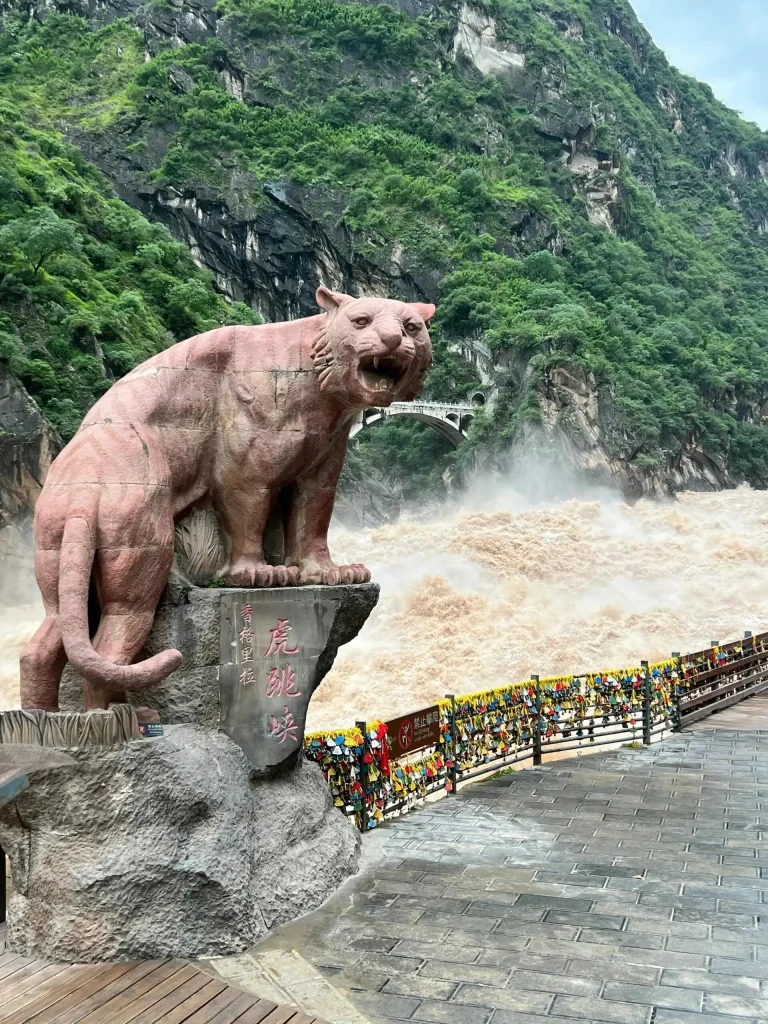
Some treks are famous because they’re difficult. Others because they’re remote. Tiger Leaping Gorge is famous because it’s perfect. A two-day walk along a cliff-edge trail above one of the world’s deepest gorges, with the Jinsha River (upper Yangtze) roaring 3,900 meters below snow-capped peaks, passing through Naxi farming villages, wildflower meadows, and mountain guesthouses where the food is home-cooked and the sunsets are free.
Located between Lijiang and Shangri-La, Tiger Leaping Gorge has earned its place on every serious trekker’s bucket list — and for good reason. The high trail, carved into the mountainside above the gorge, is consistently ranked among the top 10 day hikes in the world by National Geographic, Lonely Planet, and virtually every outdoor publication that’s sent a writer to walk it. But you don’t need to be an experienced mountaineer: the trail is well-marked, the guesthouse network is reliable, and tens of thousands of hikers — from seasoned trekkers to adventurous first-timers — complete it every year.
This guide covers everything you need to plan and complete the hike: trail options, day-by-day itinerary, what to pack, where to sleep, and the practical logistics that will make the difference between a good trek and an unforgettable one. For the big-picture Yunnan planning, see our ultimate Yunnan travel guide and our top things to do in Yunnan.
What this guide covers: Why Tiger Leaping Gorge is world-class → Trail overview (high trail vs. low road) → Day-by-day itinerary → The 28 Bends → Where to stay → What to pack → Getting there → When to go → Safety & fitness → FAQ.
Understanding the Gorge: Geography & Trail Options
Tiger Leaping Gorge stretches for 15 kilometers along the Jinsha River, wedged between two massive mountain walls: Jade Dragon Snow Mountain (5,596m) to the south and Haba Snow Mountain (5,396m) to the north. The vertical drop from the peaks to the river is nearly 3,900 meters — making it one of the deepest river gorges in the world.
The gorge is divided into three sections: Upper Tiger Leaping Gorge, Middle Tiger Leaping Gorge, and Lower Tiger Leaping Gorge. Most hikers focus on the Upper and Middle sections, which contain the best trail, the most dramatic scenery, and the famous tiger-leaping stone where legend says a tiger once jumped across the narrowest point of the Jinsha River.
There are two ways to experience the gorge:
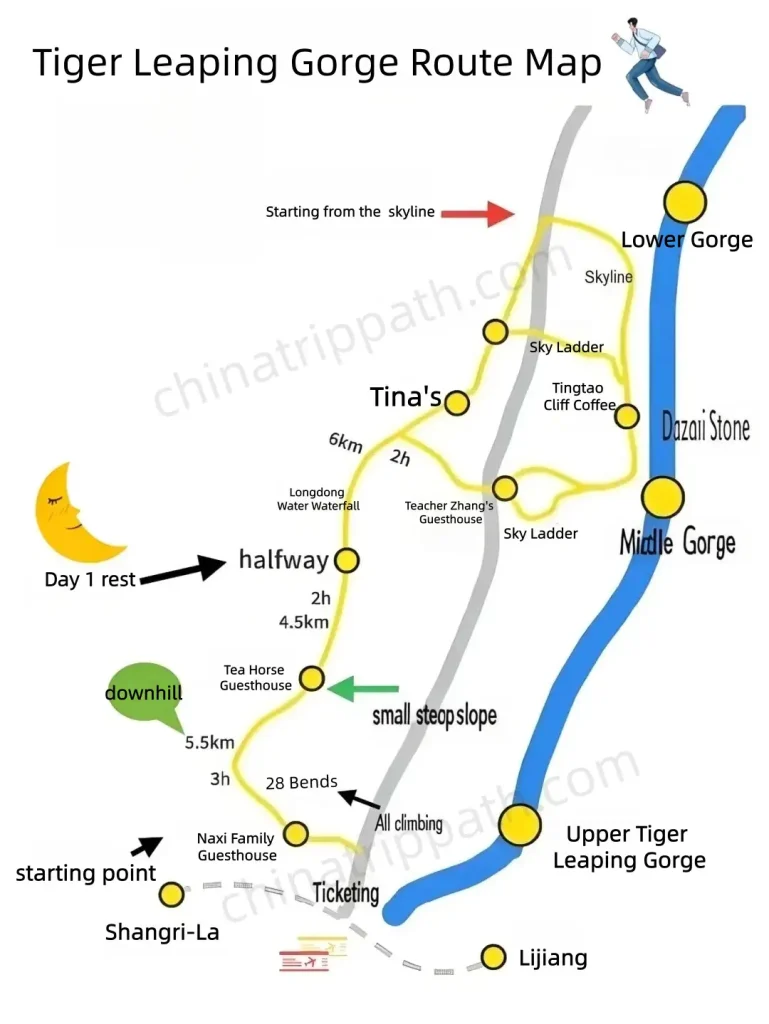
The High Trail (recommended): A mountain path that traverses the northern rim of the gorge at 2,200–2,700 meters elevation. This is the world-famous trek — the one that earns all the superlatives. It takes 1–2 days, passes through Naxi villages and guesthouses, and delivers the panoramic views that make this hike legendary. The trail is roughly 22 kilometers from Qiaotou (the western entrance) to Tina’s Guesthouse (the common endpoint).
The Low Road: A paved road that follows the river at the base of the gorge. Tour buses use this road, and it’s suitable for visitors who can’t hike but still want to see the gorge. It provides access to the Upper Tiger Leaping Stone viewpoint. Impressive, but not the same experience as the high trail.
Day-by-Day Itinerary: The Classic 2-Day High Trail
Day 1: Qiaotou to Halfway Guesthouse (6–7 hours hiking)
The trail begins at the village of Qiaotou on the western end of the gorge. From the trailhead, the path climbs steadily through farmland and scattered Naxi homes before entering the mountainside traverse that defines the high trail experience. The first two hours are the most physically demanding — a sustained uphill climb that gains about 500 meters of elevation.
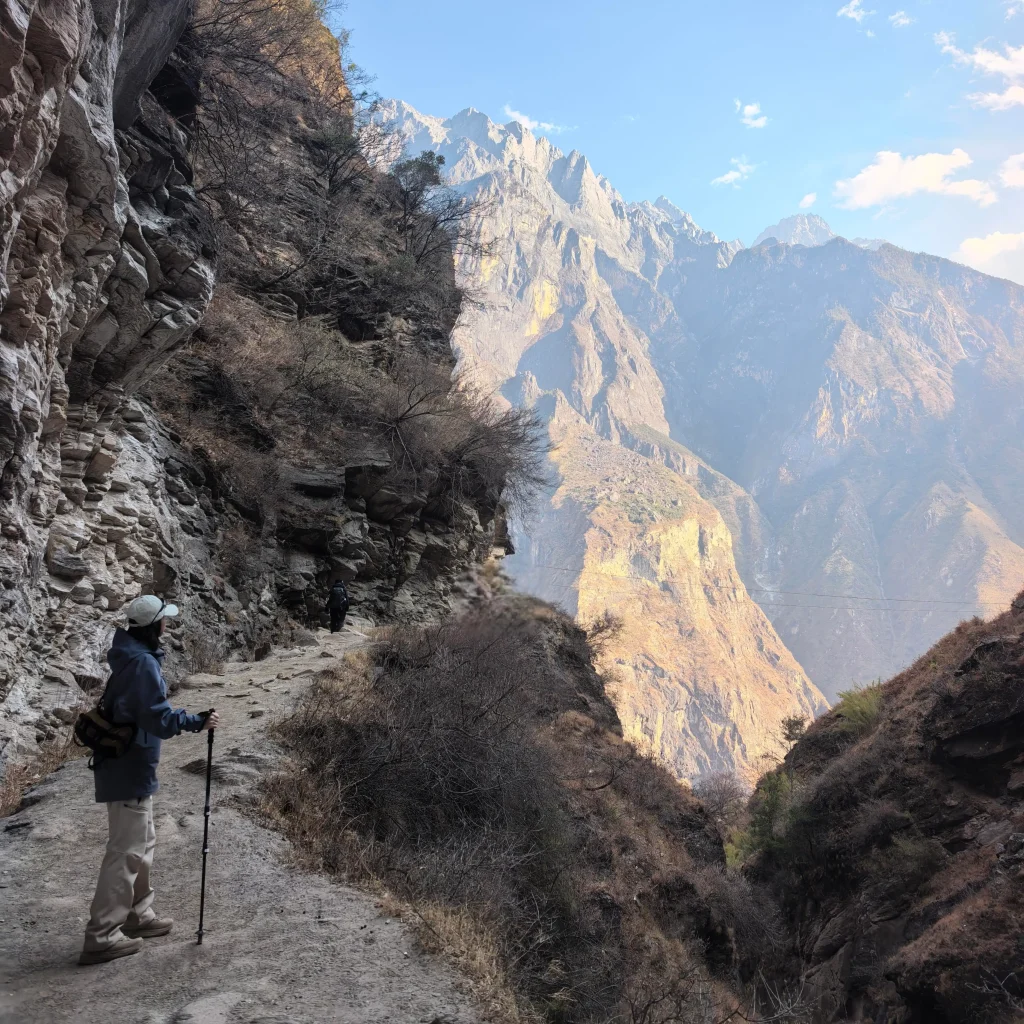
Once you reach the high path, the trail levels out and the scenery opens up spectacularly. You’re walking along the rim of the gorge, with the Jinsha River visible thousands of meters below, Jade Dragon Snow Mountain filling the southern sky, and Haba Snow Mountain’s glaciers gleaming behind you. The trail is narrow in places — sometimes just a meter wide with a steep drop — but well-maintained and never technically difficult.
The route passes through several small Naxi farming settlements where villagers sell cold drinks, fruit, and simple meals. Around the midpoint, you’ll reach Naxi Family Guesthouse — a popular lunch stop with outstanding gorge views from its terrace.
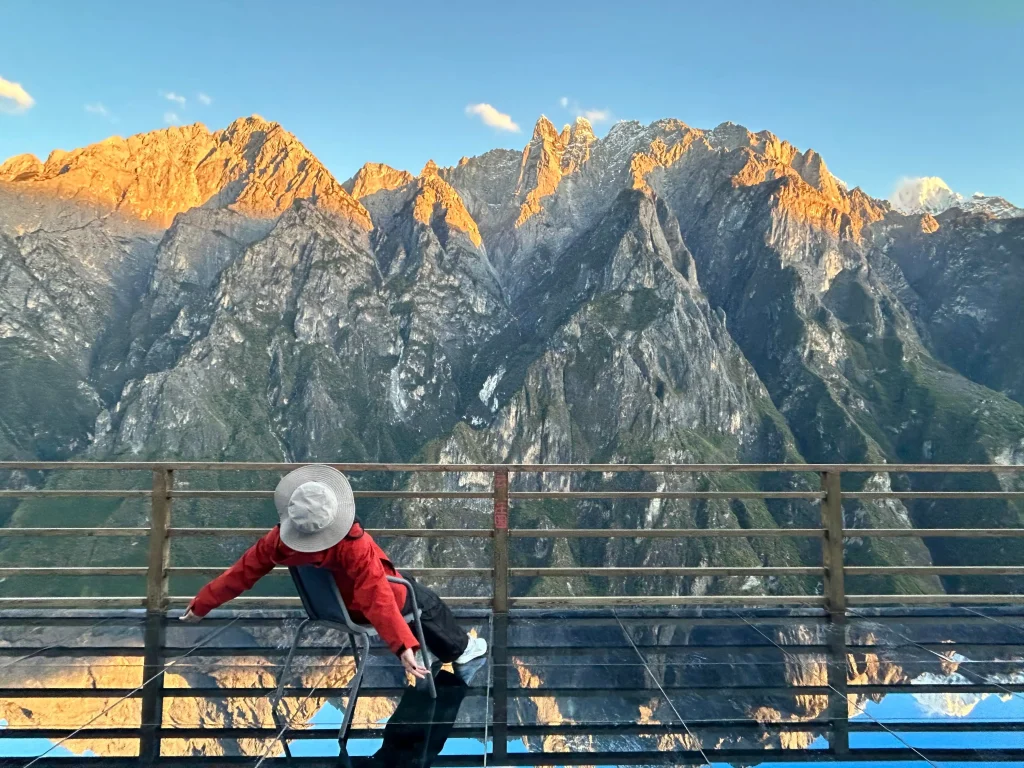
The day ends at one of the guesthouses clustered around the “Halfway” point — the most popular being Halfway Guesthouse (Zhōngtú Kèzhàn) and Tea Horse Guesthouse. Both offer basic but clean rooms, hot showers, and home-cooked dinners eaten on terraces overlooking the gorge. Watching the sunset paint Jade Dragon Snow Mountain gold from the Halfway Guesthouse terrace is one of the great moments of the trek.
Trail stats — Day 1: ~14 km, 800m elevation gain, 300m elevation loss. Moderate–challenging.
Day 2: Halfway Guesthouse to Tina’s via the 28 Bends (4–5 hours hiking)
The second day is shorter but contains the trek’s most famous (and most feared) section: the 28 Bends (Èrshíbā Guǎi). This is a series of steep, zigzagging switchbacks that climb 400 meters up a near-vertical hillside to the highest point on the trail. It’s exhausting — there’s no sugarcoating it — but it’s also the moment when the views reach their absolute peak. At the top, you can see the full sweep of the gorge, both snow mountains, and the Jinsha River curving into the distance.
After the 28 Bends, the trail descends gradually through pine forest and farmland toward Tina’s Guesthouse, the traditional endpoint of the high trail. Most hikers arrive by early afternoon, leaving time for an optional side trip: the trail down to Middle Tiger Leaping Gorge (Zhōng Hǔtiào), where you can descend a series of ladders and paths to the river’s edge and stand on the rocks as the Yangtze thunders past just meters away. This detour adds 1.5–2 hours and significant vertical gain (both ways), but the raw power of the river at close range is extraordinary.
From Tina’s, you can arrange transport to Shangri-La (2.5 hours by bus/car) or back to Lijiang (2.5 hours). Many hikers continue directly to Shangri-La, making Tiger Leaping Gorge a natural bridge between the two cities — a transition from the Naxi lowlands to the Tibetan highlands that feels both physically and culturally dramatic.
Trail stats — Day 2: ~8 km, 400m elevation gain (28 Bends), 600m elevation loss. Moderate.
Where to Stay on the Trail
The guesthouse network along the high trail is well-established and reliable. All guesthouses offer simple private rooms (usually ¥50–150/night), hot showers, Western-style breakfasts, and Chinese home-cooked dinners. Wi-Fi is available at most. You don’t need to carry camping gear or much food — this is a guesthouse trek, not a wilderness expedition.
Top picks:
Naxi Family Guesthouse: A popular lunch stop roughly one-third of the way along Day 1. Excellent gorge views from the dining terrace. Good if you want a shorter Day 1 and a longer Day 2.
Halfway Guesthouse (Zhōngtú Kèzhàn): The most famous guesthouse on the trail — a legendary stop with a sunset terrace that has been photographed by a generation of backpackers. Rooms are basic but the atmosphere is unbeatable. Book ahead in peak season.
Tea Horse Guesthouse: Near Halfway, with slightly newer rooms and equally good views. A reliable alternative if Halfway is full.
Tina’s Guesthouse: The endpoint of the high trail. Good rooms, a restaurant, and organized transport to Shangri-La or Lijiang. A good base for the optional Middle Tiger Leaping Gorge side trip.
What to Pack
Tiger Leaping Gorge is a well-supported guesthouse trek, so your packing list is lighter than for a wilderness hike. Essentials:
Footwear: Sturdy hiking shoes or trail runners with good grip. The trail has loose gravel and steep sections — sandals or fashion sneakers won’t do. Break in new shoes before you arrive.
Daypack: A 25–35L daypack with water, snacks, rain layer, sunscreen, and camera is all you need. Leave your main luggage at your hotel in Lijiang or Shangri-La (most hotels will store bags).
Clothing: Layers. Mornings and evenings are cool at altitude (2,200–2,700m), but midday hiking is warm. Quick-dry shirt, fleece or light jacket, rain shell, hat, and sunglasses.
Water & snacks: Carry at least 2 liters of water at the start of each day. Guesthouses and trail vendors sell bottled water and snacks, so you can refill along the way.
Other essentials: Sunscreen (UV is strong at altitude), headlamp/flashlight (guesthouse power can be unreliable), basic first aid (bandages, painkillers), and cash (some guesthouses don’t accept mobile payment).
Getting There & Away
From Lijiang: Buses to Qiaotou depart from Lijiang Bus Station (2 hours, ¥35–40). You can also hire a private car (¥200–300) for more flexibility.
From Shangri-La: Buses to Qiaotou (2 hours) or arrange transport to the eastern end (Tina’s/Daju) and hike west-to-east.
After the hike: From Tina’s Guesthouse, buses and shared vans run to both Shangri-La (2.5 hours) and Lijiang (2.5 hours). Many hikers use the gorge as a transit between the two cities — hiking from the Lijiang side and continuing to Shangri-La after, which makes for an exceptionally dramatic journey from Naxi to Tibetan culture.
Direction: Most hikers walk west-to-east (Qiaotou → Tina’s), which keeps the best views in front of you. East-to-west is also possible and slightly easier (less total uphill).
For multi-city route planning, our Yunnan itinerary guide shows how to incorporate Tiger Leaping Gorge into 7, 10, and 14-day Yunnan routes.
When to Go
Best months: April–June and September–November. Clear skies, moderate temperatures, and the best mountain visibility. Spring (April–May) brings wildflowers on the trail; autumn (September–October) brings golden light and crisp air.
Monsoon season (July–August): Hikeable but challenging. Rain makes the trail slippery, clouds often obscure the mountains, and there’s an increased risk of rockfall and landslides. The gorge is at its most powerful — the river swells dramatically — but visibility is unreliable.
Winter (December–February): Cold at altitude (below freezing at night) but often clear and dry. Fewer hikers, excellent mountain views. The guesthouses remain open but bring warm gear.
Fitness & Safety
Fitness level: Moderate. The trail is well-maintained and doesn’t require technical skills, but it’s a sustained mountain walk with significant elevation changes. The 28 Bends are genuinely steep. Anyone who hikes regularly will be fine; complete beginners should be prepared for tired legs and heavy breathing at altitude.
Altitude: The trail ranges from 1,800m to 2,700m — not high enough for altitude sickness for most people, but enough to make you breathe harder during climbs, especially if you’ve just arrived from sea level. If you’re coming from Lijiang (2,400m), you’ll already be somewhat acclimatized.
Trail conditions: Generally good, but some sections are narrow with steep drops. A few rocky passages require careful footing. In wet conditions, slippery stones are the main hazard. Trekking poles are helpful but not essential.
Safety tips: Stay on the marked trail. Don’t hike in heavy rain (rockfall risk). Start early each day to finish in daylight. Carry enough water. Tell your guesthouse your plan. Cell signal is available at most points along the trail. The gorge is well-traveled — you’ll rarely be alone for long.
For the cultural context of the Naxi communities you’ll pass through on the trail, read our culture guide. And for Yunnan’s broader outdoor adventures, see our top things to do in Yunnan.
Moderate. The trail is well-maintained and doesn’t require climbing or technical skills. The hardest section is the 28 Bends — a steep 400-meter climb over switchbacks — but it takes less than an hour. Anyone with reasonable fitness who hikes occasionally can complete the trek. Complete beginners should go at their own pace and start early.
Possible but not recommended. A one-day speed hike covers the distance but robs you of the best parts — the guesthouse terrace sunsets, the morning light on the mountains, and the relaxed pace that lets the scenery sink in. Two days / one night is the standard and ideal itinerary.
No. The trail is well-marked with painted arrows and signs. The guesthouse network means you’re never far from help. That said, a local guide (available in Qiaotou, ¥200–300/day) adds cultural context — they can explain the Naxi farming villages, identify plants, and share stories about the gorge.
Yes, with normal precautions. The main risks are slippery stones in rain, narrow trail sections with drops, and rockfall after heavy rain. Stay on the marked trail, don’t hike in storms, and wear proper footwear. Thousands of hikers complete the trail safely every year.
From Tina’s Guesthouse (the trail endpoint), buses and shared vans run to Shangri-La in about 2.5 hours (¥50–65). You can also arrange a private car. The road climbs from the gorge up to the Tibetan plateau — a dramatic landscape transition. Many hikers continue directly to Shangri-La after finishing the trek.
The gorge entrance fee is ¥65 (as of 2024), payable at the Qiaotou entrance. Keep your ticket — it may be checked at points along the trail and at Middle Tiger Leaping Gorge.